

mailing list
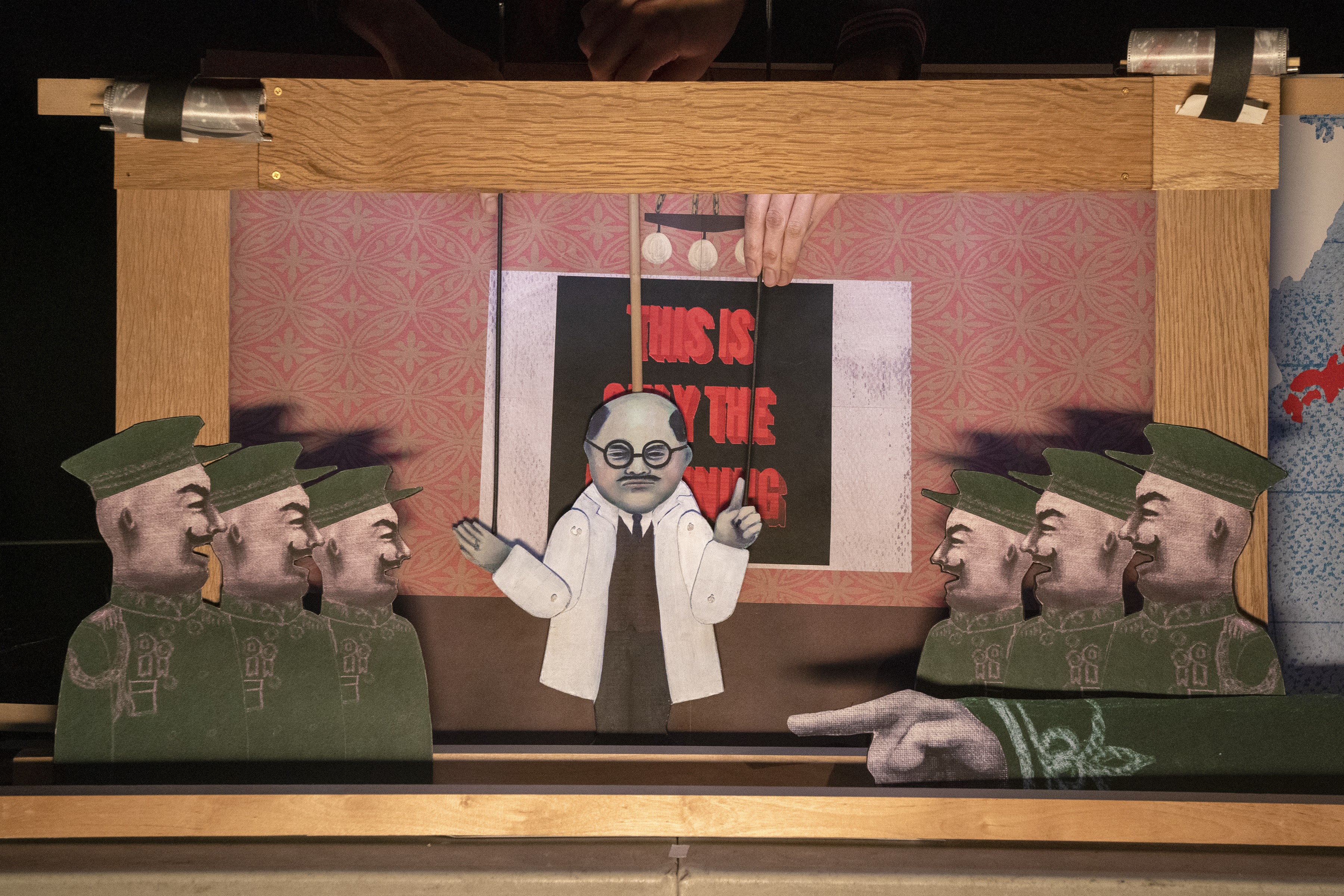
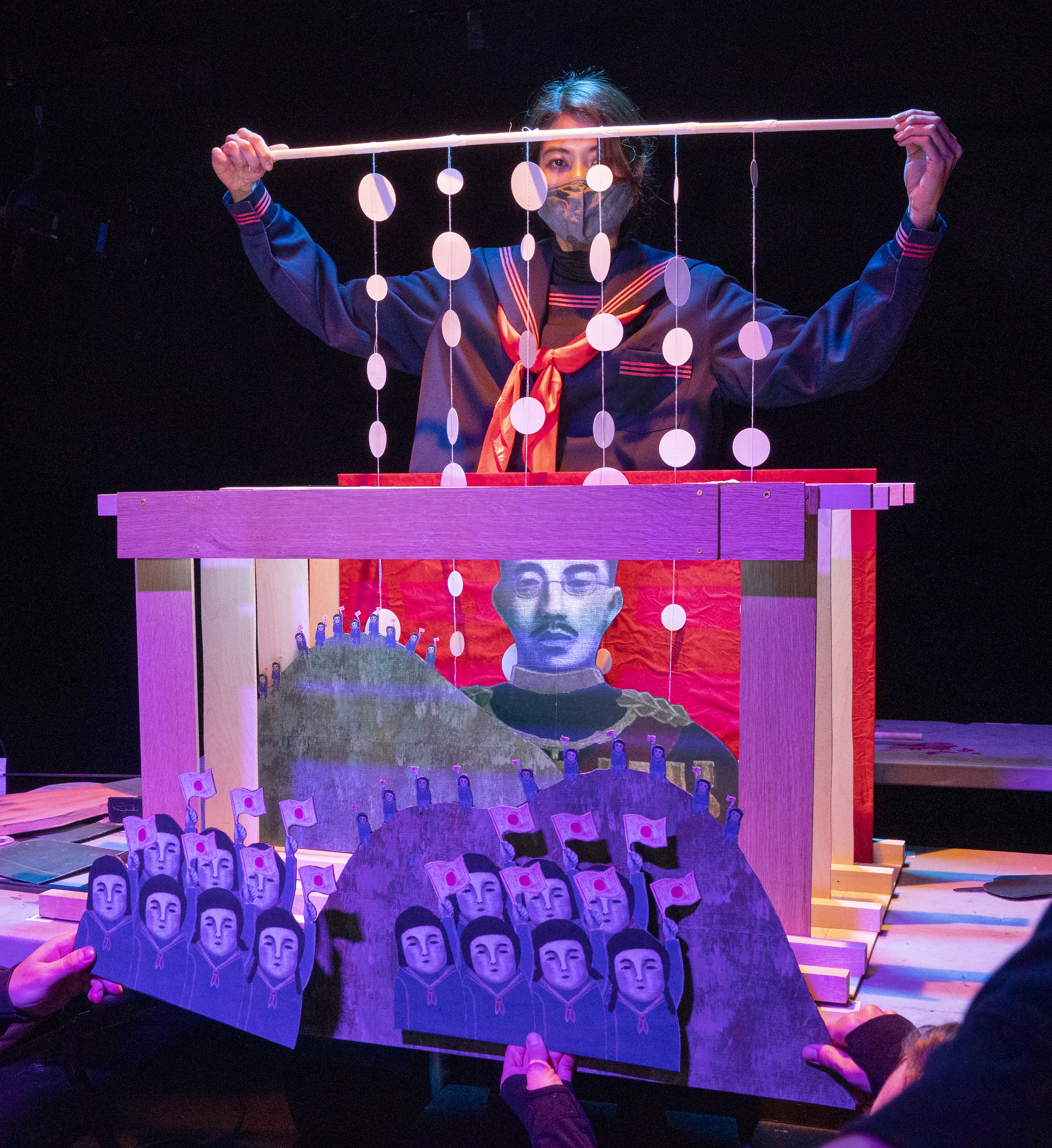
Inspired by Imperial Japan’s stranger-than-fiction secret weapons that floated over America during World War II, 9000 Paper Balloons is a poetic and eerie performance that examines distance: the distance between two friends, between two enemies, two cultures and two generations. New York-based Japanese artist Maiko Kikuchi and American puppeteer Spencer Lott blend puppetry, animation and masks as they weave their own family histories into a surreal and visually stunning collage that speaks to the past and the future. 9000 Paper Balloons will run for three performances on October 28, 29 and 30 at Japan Society as part of the Society’s 2022-2023 Performing Arts Season.
For this exclusive Hatchers interview, Japan Society’s Artistic Director Yoko Shioya spoke one-on-one with co-creators Kikuchi and Lott to discuss 9000 Paper Balloons, the New York puppet scene, and why puppet theater isn’t just for children.
Yoko Shioya: How did the two of you first meet?
Spencer Lott: I saw Maiko’s work at St. Ann’s Puppet Lab and was blown away. Anytime I saw that she was performing around the city I made sure to get a ticket. I love her solo performance work, it’s totally unique.
Maiko Kikuchi: What I remember, we were both performing at a puppet slam and I couldn’t watch Spencer’s performance, because I had to hide backstage. I remember he was performing and the audience feedback was phenomenal and I remember thinking “I want to see this piece!” After the performance we met and Spencer said, “Are you Maiko? Your piece is amazing!” I saw Spencer’s play, Blossom at Dixon Place, and it was beautifully made and so when he asked me to collaborate I was like “Of course! Why not!”
YS: Could you describe the puppetry scene in NYC? Does everyone know everybody else in that scene?
MK: Yes! It’s definitely small. It’s very particular because I am from Japan, which has Bunraku, but few people actually pursue it. It’s very traditional; we know about it, but I never saw it live when I was living there. The first time I saw puppetry was when I came to New York and I realized how different puppetry is in Japan and the US. With Broadway and downtown theaters there are festivals and residencies, and the entertainment field is concentrated in New York City so people who want to train in puppetry gather here. It’s not spread all over the country.
SL: The NYC puppet scene is incredibly interconnected. There’s lots of overlap between the puppeteers who perform on Broadway or downtown and for Film/TV. A number of puppeteers focus primarily on performance, while others focus on fabrication, but there’s not many of us so we work with each other often. There is a strong tradition of mentorship in the puppetry community and means even though it’s small, it has deep roots.
YS: How often do you find yourselves explaining that puppetry is not a medium just for children? Is that misconception a problem in your eyes?
MK: For me, the puppet is an extension of expression about my art. That means I don’t think about the age of the audience. The viewers of my paintings and my puppet performance are the same. Perhaps some of my work is not for children, but I find that children may very well appreciate it too.
SL: New York audiences are pretty savvy. The venues that typically program puppetry (St. Anns, LaMama, Dixon Place, Japan Society) are for adult audiences and I think that audiences who grew up with puppets on television get a kick out of theatrical puppetry with adult themes. Maiko and I both tend to create work that is fantastical and sometimes that is conflated with something simple or less sophisticated. We hope our audiences are able to enjoy our work like a well-written poem. Part of our craft is creating something that appears simple on the surface but allows for sophisticated themes and asks our audiences to engage on multiple levels.
YS: What inspired the creation and collaboration of your current project, 9000 Paper Balloons and how did the piece change over the course of your collaboration?
SL: I first heard the story of the Fu-Go project and the paper balloons on an episode of Radio Lab and I was instantly captivated. I reached out to Maiko to see if she had heard about these balloons growing up in Japan and we started talking about what a bilingual English/Japanese show might feel like. Soon after we invited writer Liz Hara to join us. The original proposal was for three theater makers – one american artist, one japanese artist, and one japanese-american artist. Liz Hara’s career was taking off and she got pulled to LA to work on a network sitcom, but Maiko and I were accepted into the HERE Artist Residency Program and started developing the play!
MK: Our first intention for the piece was to focus on the history, but eventually we wanted to make our own original story with the same themes. As we worked, we discovered deeper connections with our own family histories. The path of inspiration from the original historical story to how we finished was very interesting and not at all a straight line.

YS: Paper Balloons is about war, but I would also say it is about the distance between your lives today and your grandparents’ lives. How do you see the piece resonating with viewers given the current state of the world?
MK: Even though we have not experienced war, both of our grandfathers’ generations were rooted in this big war that is at the center of 9000 Paper Balloons. I can only imagine how horrible war is, but luckily that’s not where we live. Whenever I hear how my grandfather survived being a prisoner of war, it sounds like a kind of a miracle. If my grandfather wasn’t an actor in the military theater, he probably would have died. Theater saved his life.
SL: Distance is definitely a central theme to the play. We explore the distance between our generation and our grandfathers, the difference between America and Japan, the distance between a fighter jet and a paper balloon. We know that war capitalizes on that distance, both real and perceived. War is a throughline in our play, but our central question is how can we collapse the distance between us? We aren’t pretending that this puppet show is going to end war. We have audience members in NYC who are living in fear from violence due to AAPI hate. We have audience members with family members in Ukraine. We are witnessing moments in 2022 that remind us the distance between our generation and the WW2 generation may not be all that distant after all.
Learn more about Japan Society >