

mailing list
“Invisibility allows for a
kind of creative thinking.”
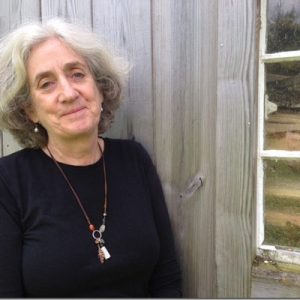
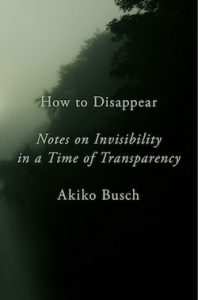
Akiko Busch writes about design, culture, and nature for a variety of publications. Her collection of essays, How to Disappear: Notes on Invisibility in a Time of Transparency was published by Penguin Press in 2019. The Incidental Steward, her essays about citizen science and stewardship, was published by Yale University Press in 2013 and awarded an Honorable Mention in the Natural History Literature category of 2013 National Outdoor Book Awards. She is also the author of Geography of Home: Writings on Where We Live, The Uncommon Life of Common Objects: Essays on Design and the Everyday, and Nine Ways to Cross a River: Midstream Reflections on Swimming and Getting There from Here.
She was a contributing editor at Metropolis magazine for twenty years, and her essays have appeared in numerous national magazines, newspapers, and exhibition catalogues. Currently she is on the faculty of the MA Design Research program at the School of Visual Arts and is a visiting teacher at Bennington College where she teaches environmental writing. Her work has been recognized by grants from the Furthermore Foundation, NYFA, and Civitella Ranieri. She lives in the Hudson Valley and makes it a point to swim across the Hudson River once a year.
Where does your inspiration for How to Disappear derive from?
We all live to see and be seen. We know this! Being seen, being recognized, being acknowledged is vital to human experience. Social visibility is vital to our happiness, to the sense we have of ourselves, and when it diminishes, we suffer. The gaze is vital to human connection and interaction. The Me Too movement and the Black Lives Matter movement have the power they do today, because it is their aim to put populations often unseen and unrecognized back into social and political visibility. We all need to be seen. This is the given!
But I think the imperative to go unseen can be just as critical. To be inconspicuous. And I think this is something we tend to lose sight of. In our age of transparency, our increasingly visual culture, social media and the surveillance economy in which tech companies routinely harvest user data, when facial recognitions systems document our actions and whereabouts, and a whole host of other conditions that erode our traditional notions of privacy, visibility seems to be becoming increasingly fundamental to our ideas of who we are. And I think we lose something there. And so I wanted to explore that in my book How to Disappear.
“Visibility, I think, can be distracting.”
Why is it a positive condition to be invisible?
Visibility, I think, can be distracting. When identity is derived from projecting an image in the public realm, something is lost, some core of identity diluted, some sense of interiority and authority compromised. It seemed to me there is another way to think about this. And to imagine the unseen state not as being about being overlooked and discounted, not about senseless conformity or complacent isolation, but about maintaining propriety, authority, voice. And how in a range of human experience, invisibility can be a more positive experience.
What advice can you share with readers who are “always connected”?
Connectivity is vital to human experience, to human exchange. Of course we all have the impulse and incentive to be seen, and social media offers us myriad way to make ourselves visible. But I think the important thing is to know you have a choice of when and how to be seen, and to practice that choice. It is a way of being attentive. In using social media, to practice some sense of discrimination of what you put out into the world. A sense of disquiet can come from relinquishing—unreservedly and unconditionally—the personal information that is key to retaining a sense of identity. When private experience is indiscriminately offered for public consumption, ideas of interior self can be so easily devalued.
“You have a choice of when and how
to be seen, and to practice that choice”
Why does disappearing aid creativity?
When I started to consider invisibility as a positive experience, I discovered that across a range of human experience, invisibility can be a more positive condition. It can help us be more creative, more connected to each other and to ourselves. And of course the place to start was with kids. When we are children, invisibility enables creative thinking. Far from being something to fear, it is a route to independence and resourcefulness. We learn about the evanescence of words through invisible ink. And the idea of disappearing is a staple of children’s literature. A hat, a ring, a cloak, a cape–as accessories to invisibility, all of these give kids a sense of protection, power, knowledge.
As children we can experience invisibility spatially as well. The upper limbs of the beech tree where I found haven as a child offered me a place remote from my family. It was where I could imagine my life as something apart from theirs, and each branch of the tree was a step towards autonomy. Looking back it sounds like a simple thing, but it was where I could disappear. And when I disappeared this way, I realized I did not need to be with my family, or even to be in their view, to be real. The sense I had of my own being could flourish when I was unseen. The empire of childhood is full of these places, not just in trees, but in attics and closets, under stairs, shelves, and beds or inside cabinets, secret spaces where children can vanish into their own thoughts, imaginations, private worlds.
Kids don’t just love to be invisible. They also love to engage with what is invisible. Their invisible friends come in all shapes and sizes, serving as confidantes for secrets, subjects of devotion, practice companions. They allow kids to imagine what it is to be known by another. And help them to develop a deep core of private awareness. Children use imaginary allies to work out social puzzles. Make-believe conversations help them make cognitive leaps. And for adolescents especially–who are stepping away from their parents, realizing all the while their own peers may not know the way very well either–such imaginary friendships can work as a kind of safety net. These relationships are not simply a way of knowing themselves as they grow into adulthood, but a way of discovering how they become attached to others. So in all of these ways, invisibility allows for a kind of creative thinking.
How do you, personally, disappear, and why?
Being unseen can be useful to us in a different way in the adult world. As a woman of a certain age, I know this. It can enable our sense of empathy. Age comes with a flickering sense of presence. We are in and out of public view. But we can also entertain a wider set of choices about when and how to be seen. And this can work for us. Rereading Virginia Woolf, I encountered the main character of her novel, Mrs. Dalloway, a woman of means living in London shortly after the First World War. Walking down a street feeling unnoticed, and she reflects that it is often only by their gloves, shoes, and husbands’ names that women are known. Yet at a certain age, she also found herself more attentive to those around her. And with the gift of “knowing people by instinct.” Being unseen doesn’t so much limit one’s life as sustain and inform it. It’s not a matter of being ignored or dismissed, but of being intuitively present, tuned into and more fully integrated with the world around us.
“Going unrecognized can help us connect
more easily with the emotional states of others”
As a writer, Woolf was perceptive and prescient about human behavior, and a century later, modern social research confirms her thinking. Human beings are an altruistic species, but it turns out that our sense of goodness and fairness has less to do with background and temperament and more to do with status and reputation. The data suggests that being inconspicuous can guide us towards a more humanitarian view of the larger world; going unrecognized can help us connect more easily with the emotional states of others. And help us better understand our place in the larger scheme of things.
Is there anything you’d like to share in terms of racial injustice and invisibility?
I think most of us today across many different social groups are profoundly grateful for that social justice tool of the times—the cell phone video. Over the last decade, these cameras have documented the everyday abuses—whether by law enforcement or by white supremacists—on marginalized communities, African American men especially. And how many lives have been lost, day after day, week upon week, year by year. When cell phone videos began to document these assaults, bringing them into public view, they changed public understanding and public discourse.
But I am hearing something else now as well. For many members of the African American community, the constant playing and replaying of these videos can be traumatizing. They have become their own from of terrorism. I have heard Black activists calling for restraint on showing these videos because they also perpetuate a custom we seem to have in this country of turning Black death into spectacle. So how much of this do we need to see over and over again? And are our imaginations so impoverished that we cannot believe these social atrocities exist without being constantly barraged by visual evidence? So I think there is something in this question that captures the tension and the anxiety in our culture of what needs to be seen, when, how and under what circumstances.
“We all have the impulse
and incentive to be seen”
In relation to your book, The Incidental Steward how can current times help people reacquaint themselves with nature?
When I wrote The Incidental Steward, I was interested in how people pay attention to the natural world. And it seemed to me that it comes naturally to people to take measure of things. Maybe it has to do with our heartbeat and pulse, but there seems to be some intrinsic pleasure we find in taking measure. Maybe that’s one reason people wear Fitbits to count their steps or use apps that record how they breathe in sleep. Anyway, this ease we have with taking measure has a place in how we look to the natural world—whether it is in participating in a bird count, tracking the dates of monarch migrations, recording rainfall, studying the geographic distribution of fireflies, or the more ephemeral exercise of determining whether a lake has iced over. And today, of course, GPS, digital photography, phone apps, and internet data bases can all help us track and record reliable information that can be useful to scientists studying habitats, species migration, climate change, and so much more. But such searches and the information they turn up can also help us in finding our place in the world around us.

What is your favorite object and why?
One of my favorite objects is a small black stone, really just a chunk of lava, I picked up s few years ago on a beach in Iceland. The Icelandic people have an abiding belief in the Huldefolk, an invisible population that is likely a remnant of Celtic and Nordic mythology. But the belief in this population also signals a respect for the entire unseen world. And so this little black rock reminds me of this. It is a little placeholder for all those things we cannot see or know. The invisible world is a place to which the human imagination has not yet found a clear path. And so this little rock, sometimes in my pocket, sometimes resting on my windowsill, is a little souvenir of that idea.
What has been a pivotal moment in your career?
An important moment in my career came in the sixth grade when I read Jack London’s short story, “To Build a Fire.” It is the story of a man in the sub-zero boreal forest in the Yukon. He freezes to death because his mind has not been able to grasp what such temperatures do to the human body. London writes that “The trouble with him was that he was not able to imagine. He was quick and ready in the things of life, but only in the things, and not in their meanings.” London talks about the gargantuan imagination required to comprehend the world as it is. This idea has stayed with me ever since, and it is why I prefer nonfiction to fiction.
What emotions do you hope to evoke when people experience your work?
Thoughtfulness. I hope.
What advice can you share with readers surrounding patience?
I go with what Kierkegaard said: “Patience is always just as active as it is passive, and just as passive as it is active.”
“Swimming in a river can confer
a fluid axis that recalibrates you”
Tell me about your annual Hudson River Swim.
Every summer I swim across the Hudson River, a one-mile passage from Newburgh to Beacon, as part of a fundraiser for the environmental organization, River Pool at Beacon Inc. The river pool is a small flow-through pool in the river meant to introduce kids to the joys of river swimming, and by way of that, to environmental stewardship as well. But swimming in a river, nearly any river, connects you with a flow, sometimes gentle, sometimes grand, but always a sense of momentum so much larger than yourself. Swimming in a river—rather than in a pond or pool or lake – answers to that part of yourself that wants to be swept away. It is a way to right yourself and a way of stepping outside of the framework of your own life. The natural world has ways of reaching us that are unpredictable and astonishing, and swimming in a river can confer a fluid axis that recalibrates you, that sets you right and anew every time.
What’s your philosophy for life
When I began writing, it was often about design. But I defined design as being about a sense of fit—how a spoon fits the hand, how a body fits into a chair, how a piece of furniture fits in a room, how a house fits in to the landscape. This way of looking at design took me easily to the natural world, and questions about how people could find a sense of fit with the natural environment. Not long after that, I began to think about invisibility; ways to disappear simply offered another way of thinking about how we can find a sense of fit with the world around us. So if I have any such philosophy, it has to do with finding this sense of fit.