

mailing list
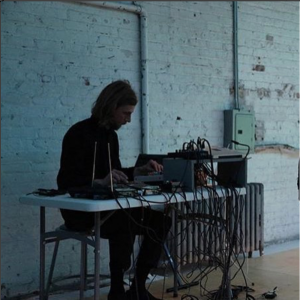
Jeff Kolar is a sound artist, radio producer, and curator working in Chicago. He is the Founder and Artistic Director of Radius, an experimental radio broadcast platform established in 2009. His work, described as “speaker-shredding” (Half Letter Press), “wonderfully strange” (John Corbett), and “characteristically curious” (Marc Weidenbaum), activates sound in unconventional, temporary, and ephemeral ways using appropriation and remix as a critical practice. His solo and collaborative projects, installations, and public performances often investigate the mundane sonic nuances of everyday electronic devices.
Tell me about your journey to becoming a sound artist? My history was sort of weird, when I was a teenager, I was a professional BMX rider, already traveling and living a different lifestyle and underground culture. Then I got an injury and got put in the hospital. It was then I was like I need to do something, and I ended up getting a degree. I went in for a graphic design, I was a little bit older than others. I spend time and met people that started a new program about new media art, which was brand new at the time, video art and narrative video. I met a sound artist who is from New York, and he played the theremin have you ever heard of it?
I think, so what does it look like? I think you have heard it, it is played a lot of horror movies all the time there are two antennas that come out of it and you play it by not touching it.
Yes! I remember being at a show in the Lower East Side and someone was playing one there. It is a really common instrument in horror movies, because it is all about pitch and being spooky. The sound artist taught a one off course and I was already in that culture, and dive shows. I was in to metal and noise music, and met this person who exposed to me that sound can be exposed, in material – way in like a computer. I just dived in and got super immersed into it was like one of those things that is meant for you and then I get some opportunities and snowballed into it.
Do you aim to communicate a message through your art? I don’t have a single message. I have an idea to what my work does in the world, but I also don’t want to explain. I am really attracted to art that has mystery, so although I think most of my work is super pointed, I would like to open up a world where the artist can explain. Something I don’t really believe is that the artist is a master, the fun part is when artist has surprises that happen, that are unexpected. So not a specific theme or message, a lot of my work starts on concepts. Not all, but most musicians; they can just pick up a guitar and turn it into something. Usually I start from an obsessive idea, and turn it into something. Being interested, and deep diving in to something and the processes. I really enjoy the process, it makes me the most interested in the art.
How would you describe your process? It’s messy, and it’s different since I do so many different things. I always want to do better, no matter what my work is. My approach is always different, and to be better. So whether that means scaling work up or down or adding collaborators for instance; working with a harpist and making what we are making is much more like music, we are making an album which will float into a different part of the art world. It’s interesting, that work can be more much conventional. I like that idea of scattering, or something. You might see one piece of my work but you may need to see other pieces of my work to see that big picture. I think it is much more interesting then, than “here this is” “who I am“.
…and that freedom is a wonderful part of being an artist. Yeah, or else why do it? I think as an artist you have an obligation to keep pushing yourself and get better. Especially when working with artist that are much further along then you like Zena (Parkins) and Jennifer (Monson), are in their 60’s. I see there are still preaching their practice and they are seeing in their further like 50+ years, they still have a spark and that is super inspiring, as it’s pretty easy to give up.
What advice would you give to other artists? haha
…or your younger self?…I think young people, to have great idea, I try to hangout with younger people as much as possible.
I think their ideas are crazy in a good way usually, and remembering naivety. Education systems tries to put them in something (box) and my suggestion is to just keep pushing, and be inquisitive. Yeah and making art is like running from the cops, like moving forward, but still looking backwards. That chase is pretty fun, you know? Your work is chasing you, I think that puts you in a better perspective rather than the opposite, which is which is like the work is navigating you, and I am not.
Did you know what you wanted to do once you graduated? I was never taught any practical information I think at one point I was given a book that was like ‘how to survive as an artist’ and it was not relative to my interest. I just want to build my own world that I want to live in, and it works which is cool. I think it depends on what you are interested in. I never learned those practical things, I was always someone that said okay and learned the skills I just went out and said I we’ll see what happens. That might be different to like, a painter.
Tell me about your first paid project, and the journey to it…That was super hard, I mean I worked my ass off to take whatever I thought was good for me, and even if it was super small and I tried to have a good work ethic. Even if stuff bombed just see what you learned from it, and that’s more of a confidence thing. Once you think that one more person might like something and then another one does, and then two more, you can also sit normal – and then something really big happens!
What’s been your favorite project that you have done? Exhibiting at the Museum of Art and Design was a huge accomplishment. I think that show, and project was the most fulfilling and most amount of work in one thing I have ever put in. That whole project was really rewarding, I put in time for almost seven years, the first two years were totally like what is going on and then you just keep doing things over and over again, and keep on going and make sure you keep improving I think that is the biggest accomplishment for sure. Or like some other stuff that totally failed that were also really great. I had a chance to go to Slavina to do a residence where I was trying to convince the local government to let me use their air raid system. You know the systems you use for natural disasters or tornados and hurricanes, the speaker system that are all over the city? I got super close, I had meeting with the mayor, then realized culturally it means something different. So I think there is greatness also in those failures, actually they’re way more important than your biggest accomplishments, because really your biggest accomplishment is what other people are perceiving. The really big ones are when you realize something, and that’s what I what to tell younger kids too – yes you might get a pat on the back but what will hit you hard is when you’re getting better as a person, or a completely change in perspective.
Tell me more about ‘Radius’? It’s been all over the place, there has been eighty episodes! It all started because I knew one person that did a piece which I really liked, and it didn’t go anywhere. Then I had another friend that did some work and I thought there was no platform to show off their work, and for people that are really interested in this particular art of sound, which is like using radio. Two people that I knew were the first two episodes, I did a really simple email mail out, and then posted it around the web, and then it exploded! The third person (featured) was from a really big group, from France. Then all of a sudden it blows up internationally, not in the states so much, and its weird because it was a space where it was hyper local. Then the project got really big, and we started getting lots of submissions and it slowly turned into choosing specific people to be featured. Working with over 400 people from all different countries we build this weird community of people all over the world!
In what way do the other sounds artists featured on Radius inspire you? I definitely think my work has gotten better from it. It makes me think of how far can you push an idea and then actually seeing it happen. A big part of the project for me was how to make it happen, and make it to where everyone can have access to it. It become popular in Europe pretty quickly. The design of it is really good, and the French people really loved it. I mean now I think I just (accidentally) started a brand. At first that’s not really what I wanted, I just wanted to make sure people can recognize sound art easily.. Now it’s become a bigger thing and other designers can all work together, like for the exhibition at MAD.
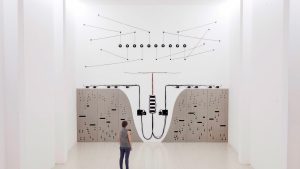
Do you enjoy collaborating? Yeah totally, for a while I was picking a different (graphic) designer for every project to get a really good mixture of things. I wanted a (visual) artist that changed things, and then artists known for one thing – like disco balls. I wanted to push the gap and work with different artists, so that the work was different, and be a totally different feel for the artist. I still do that now, but it’s in a different way. Like for this project, I am working with lighting designers and set designers. I like to think about other parts and putting it together. That’s super cool, and since I have been working with the costume designers, I am getting to know more about fashion. Especially in materials and how those people think I am super fascinated.
Is sound considered as popular as other the art disciplines? I think sound art is having a moment right now, which is cool. A lot of people are asking me that, I feel that all of a sudden people are liking it, and it is also coming into popular culture all of a sudden. Maybe people are being more admissive to things and more accepting. I think that’s why people are going to raves for something totally different. I am excited what I want for sound art is to expose more so, I think museums do it wrong. It’s weird to see sound art when there is like four of them in one room.
How would you do it differently? What I think is interesting, is having different experiences. Whatever it is that’s built, and customize the idea that art work can move in and out of galleries. I believe it should be more than that. I would push on museums, what is the point of something boring? Take me to the jungle, or an on island. Like a strange place. I think that is where sound art is put to its best, and where there is something different. Sometimes in museums it is not the place for that.
I really like Tim Hecker, I’ve seen him live a few times…Yeah, he is amazing super brilliant too! I know Tim, and we have played a couple of festivals together. I almost love his mind more than his music. I think he is so impressive, his work is amazing and the use of fog is totally ‘in’. A reality where you can’t see anything, and deal with it. People have panic attacks at his shows – I have been at his shows where people have had panic attacks, he is really in to pushing the limits!
Who is your favorite artist? Woah, that’s hard!
Well… at the moment? I think I am more into architecture right now. I think inspiration can come in all sorts of ways, and I am really inspired right now by passion.