

mailing list
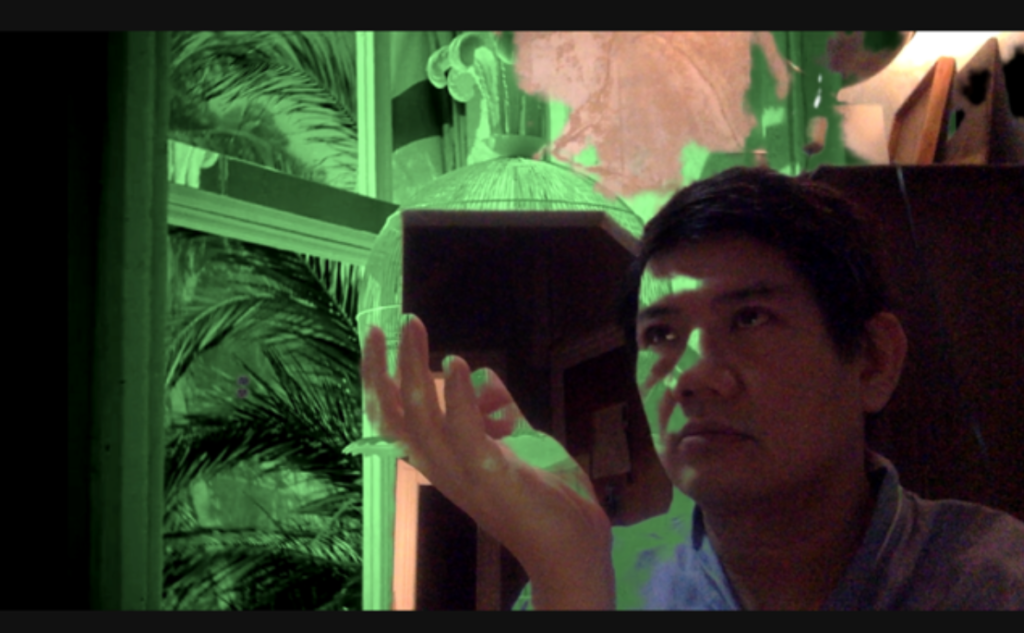
Simon Leung was born in Hong Kong, and lives and works in Brooklyn and Los Angeles. Leung’s projects in various media include an opera set in Griffith Park; a live/video performance addressing AIDS in the figure of the glory hole; a trilogy on “the residual space of the Vietnam War;” an extended proposal of Duchamp’s oeuvre as a discourse in ethics; a meditation on the site/non-site dialectic by way of Edgar Allan Poe; context-specific works centering on the squatting body as a heuristic cipher; and a twenty-year plus collaboration with the late writer and art world figure Warren Niesłuchowski. Leung’s more recent works include ACTIONS! / ADJUCNTS!, an “art workers’ theater” project on the intersection of art and labor for the Hammer Museum in Los Angeles; Rehearsal for 9 collective movements for the Gwangju Biennale; a curatorial project, Introduction to Yvonne Rainer, for the Inside-Out Art Museum in Beijing; and an internet performance for the pandemic age, hosted by the Queens Museum, called City of Squatters. At the heart of all of Leung’s work is the meditation of the ethical challenge, broadly defined, as proposition and possibility. He has received the Art Journal Award for his writing, as well as fellowships from the Guggenheim Foundation, Clark Art Institute, the Fellows of Contemporary Art, New York State Council on the Arts, New York Foundation for the Arts, City of Los Angeles, California Community Foundation and Art Matters. His work has been exhibited internationally for more than thirty years.
Hello Simon! Thanks so much for taking the time to answer these questions. Talk to me about your current feelings and emotions…
It’s summer and things are opening up after more than a year of restricted sociality, so I feel quite happy on a personal level, thanks. In the grander scheme of things, my late friend and collaborator Warren Niesłuchowski used to refer to my general disposition as one of “grim optimism,” which I think is what I am working with going forward with the world as is.
Lets start at humble beginnings, tell me about your early life, and your journey to where you are at present…
I was born and raised in Hong Kong for the first decade of my life while it was still a British colony, so I was once, literally, a colonial subject. Cantonese was my first language, and urban life was all that I’d known growing up. My Chinese family was middle class but neither intellectual nor steeped in culture, yet I cannot think of a time when I didn’t identify with being an artist since I was a child. I never wavered, and so here I am.
Tell me about your journey from Hong Kong to the US. Why the US?
Hong Kong is a city on the edge in its geographic location and its anxious relationship to China. The riots in Hong Kong in 1967, which was an extension of the Cultural Revolution on the mainland, initiated immigratioin for a lot of people and our family was simply one of many. The way my parents told the story was that Hong Kong’s future was uncertain and we were a family with three boys (I was the middle child). They wanted us to be educated abroad but couldn’t afford to send all three of us, so immigration was the only viable option. My parents considered moving to the UK, Australia, and Canada but the US turned out to be the most practical because my mother worked for an American company which sponsored our entire family.
What’s your medium…
Haha, in the 90s I used to say that “misrecognition is my medium” because I was working mostly with people’s expectations of what something is or means or is supposed to be, and the viscosity of that expectation was the center of my interest. Generally, before I think about a particular medium, I think about what kind of encounter, what kind of space and audience and tone I want to get at; about how the entirety of how the work might be received, and work from there. In practical terms, I’ve made sculpture, photography, drawing, installation, films; I write; I’ve made what I call “art-workers’ theater” where the participants portray variations of themselves; I’ve made an opera… So while I don’t have a single medium per se, I always think about how everything one does as an artist is contextual and performative, and calibrate the work in terms of pacing–the rhythm of its unfolding–even if it’s an object.
Talk to me about the importance of incorporating technology into your practice…
I don’t think about technology as being separate from materiality, so what is colloquially termed technology for me is simply one technology among other technologies. Language is a technology. The techniques of the body are technologies (in my squatting work, I think about how squatting is a technology which “conjugates the body”). That said, what is important to me in each work is to render something that reflects back on the conditions that produce that presence. For example, the way the internet is simply a part of the way consciousness and sociality and communication and politics are produced is something I don’t want to repress. I want to grapple with it. With the pandemic, a lot of what I ended up doing was talking on Zoom, so “City of Squatters” incorporated the logical and technological features and framework of Zoom into the piece, which migrated through many formats until settling as a performative lecture. For me, art is always reflexive about the conditions under which it was created and received. In the end, Zoom technology for a performance is not so different from lighting and scenic design for the stage; or the surface of the canvas for a painter in the late 19th Century.
What’s the main message you aim to communicate within your work?
That it’s worthwhile to think and feel deeply about something in a complex way. That it’s worthwhile to recalibrate the terms experiencing something through an ethical and political and aesthetic sense of being.
Does your art derive from personal experiences?
I used to think not when I was younger, but now I think yes, always, because it’s alway an index of how I experience something, even if that direct experience is thinking. Sometimes, like my work with Warren, was ostensibly about “him,” but when you dig a tiny bit deeper, you see it’s really about me spending time with him, working with him, and thinking about him–it’s almost a transcription of our friendship. Thinking in art is always personal for me because it is always relational, always in the context of why and how something gets attached to authorship. But even when it’s not strictly autobiographical or “personal, in order for something to feel like “my work” to me it needs to be something that registers in my psyche in such a way that I will keep thinking about it, and my work is, often, the material enactment of that thinking.
What emotions do you aim to evoke when people experience your work?
Haha, all the emotions! A term I’m fond of is “extracurricular emotions”–art is good at evoking extracurricular emotions.
Tell me more about the A City of Squatters….
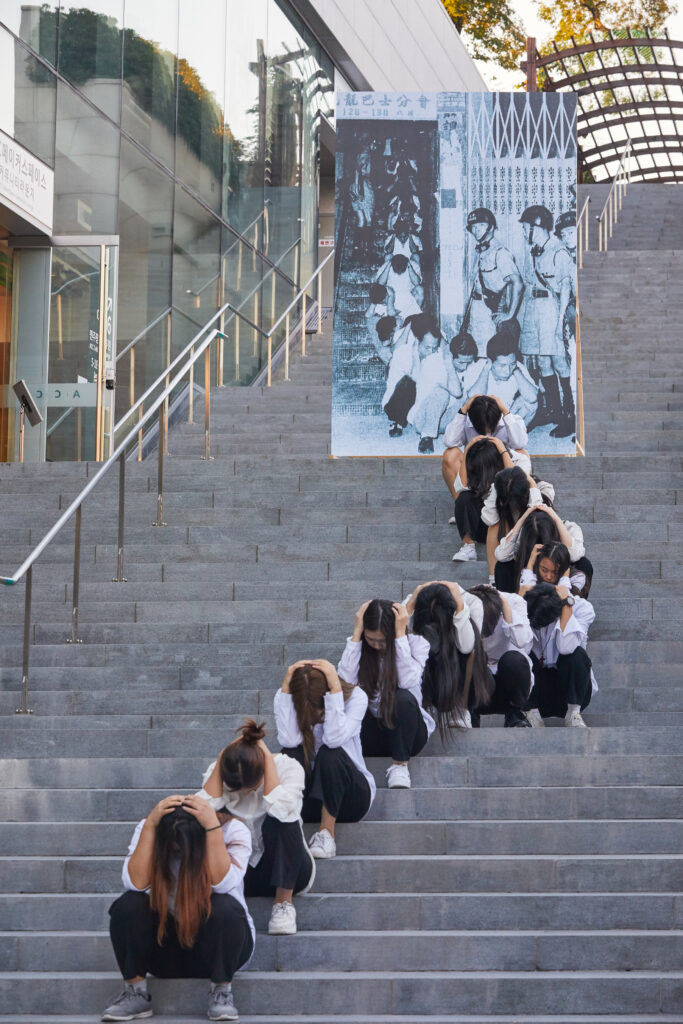
City of Squatters had a title before it had a form. Larissa Harris invited me to be a part of the exhibition at the Queens Museum and wanted three separate projects to be represented in the show. City of Squatters was the name I gave to whatever we would do. Besides War After War and POE, the idea was to present a squatting work that was performative in some way, but as the pandemic hit which made a live performance unfeasible, I kept thinking about how the piece has to be true to its time, and Zoom was a literal shared reality– so we arrived at the form of a lecture/performance to reflect back on the platform that would facilitate the piece meant staying with the trouble of the times. Fatigue, shelter, rest, and the uncertainty of the present were the atmosphere, so I thought back to how some years ago I gave a lecture at MoMA called “A Place to Rest” which meditated on how my work with Warren and my squatting works had something in common: the vulnerability of bodies out of place in search for a place to rest. After Warren lost his apartment, he spent two decades continually looking for the next bed; and of course my squatting work is always using squatting to picture a temporary resting position of those denied power. I told Larissa I wanted to wait until 2020 was over before I start writing the piece, and was glad I did because I was able to refer to the January 6 seizing of the Capitol building through these photographs from a San Francisco photo studio of Cantonese opera in Chinatown in the early twentieth century. So in the end, I suppose I wanted to get at a feeling founded on the proposition that a city of squatters means a city of refuge, and we are all strangers in need of welcome. In any case, it’s now a piece that lives on YouTube, so anyone can just google and watch it.
I’m a Poe fan, tell me more about the POE project you created…
I was commissioned by Wave Hill in the Bronx to make a work about an American author and I chose Edgar Allan Poe. I’d always known about Poe, of course, but I become interested in him due mainly to how aspects of his work–his anticipation of the Freudian unconscious; the radical ambiguity in his plots and characters; the foregrounding of artifice and deception and style–were taken up by thinkers like Lacan and Derrida in French theory, and in postmodern art discourse by Craig Owens, who echoed Robert Smithson’s preoccupation with Poe. Smithson thought that Poe’s writing was a model for art criticism, especially in describing a cornerstone of his thinking, the concept of the “site/non-site” dialectic. So I saw how I could use these ideas in and about Poe to think about what was happening around that time circa 2006: the aftermath of 9/11; the way war (the “War on Terror,” the American wars in Iraq and Afghanistan, etc.) became a normalized and perpetual way of life; and the way undigested history is hidden like secrets a Poe story. In the same essay in which Smithson discusses the site/non-site, he also quoted Yvonne Rainer, whom he admired greatly. So I began with the idea that I could have Yvonne play Edgar Allan Poe and have her dance in situ at the Poe Cottage in the Bronx, which was literally moved in the early twentieth century so that it could be preserved; and in front of a facsimile of the last remaining Poe residence in Manhattan NYU knocked down a hundred years later. Without going too much in detail, there are basically three interrelated sections, each dealing with site and non-site: the first is set in New York with Yvonne; the second is set in Poland (because Poland is Poe-Land!), where I have Warren portray characters from an amalgamation of Poe works like The Raven,The Caste of Amontillado, The Tell-Tale Heart, William Wilson, the Black Cat; and the third takes Poe’s novel The Narrative of Arthur Gordon Pym, published in the 1830s, as a script about the mid 2000s American war in Iraq.
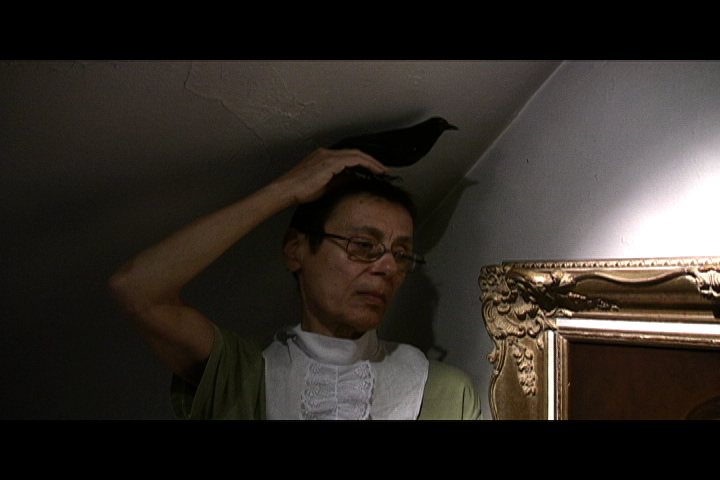
Pictured: POE (2006/2010) with Yvonne Rainer as Edgar Allan Poe
Tell me about your first important museum exhibit…
Well, if we put the emphasis on “important” I think that would be the 1993 Whitney Biennial, which is still remembered today as a pivotal moment in contemporary art.
Lets talk about censorship, do you feel completely free to create the work you want to create?
That’s a complex and a two-part question. It’s one thing to make something, it’s another to present it in public. I may feel a relative freedom in making something, but there will always be constraints in making it public. Freedom is always contextual, and a public space is never just a given thing–it is always a produced condition which needs to be maintained. A couple years ago I did a museum project in Beijing, and everything that was shown had to be pre-approved by the Cultural Bureau and the Cultural ministry–that’s the kind fo thing you simply expect when doing a museum show in China. For the last decade I’ve been working on Hong Kong which I had wanted to make and show there, but what was possible in Hong Kong just a few years ago is now no longer possible due to the National Security Law which went into effect July 1 of 2020–people are being arrested, teachers are losing their jobs, and the government is, without irony, telling art institutions to self-censor. But least we idealize working as an artist in “the West,” I think it’s important to say that there are many constraints and limits I adhere to when my work is shown in the west. The way I think about art making is not through the prism of “freedom,” but rather the reverse: how does one work with the limits of the conditions you’re in in order to imagine life differently.
What are you currently working on?
Several things, all long term projects: one of the aforementioned works on Hong Kong, a squatting project revolving around several themes–”the left,” the police, the squatting body; a three-part project based on y family set in the US, Shanghai, and Hong Kong; an opera set in Griffith Park in Los Angeles I begun in 2002 and am still working on twenty years later. All my projects are long-term projects it seems.
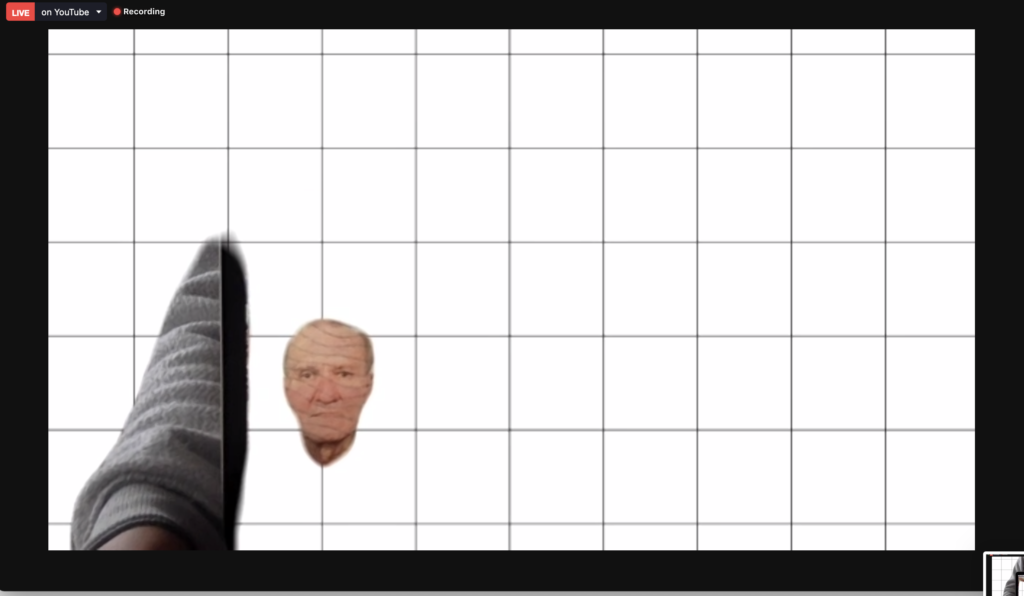
City of Squatters (2021)
Who’s been your biggest influence, and why?
The Unconscious.
There’s no “why” in the unconscious.
If you could choose to write a handwritten letter to someone, who would it be?
My father, who died more than fifteen years ago. In a way I think I had already because I once wrote something after he died thinking about him, but I probably have more to say.
What do you laugh about?
Animals often make me laugh (like a stubborn husky on YouTube).
What do you cry about?
People who, instantaneously, get a glimpse of their past happiness, real or imagined, experienced or not.
Do you have a daily routine?
No, but I wish I did. I would like to wake up very early and work for a few hours everyday, but I don’t. I work in spurts.
What rules do you live by?
I try to pay attention.
How do you get into your daily flow?
I have never thought about this! But I get a lot of thinking done in dreams, which is when I notice any flow. Otherwise, I’m just a one-foot-in-front-of-the-other kind of person.
What advice would you give to your younger self?
Be more diligent about retaining your first language.
Tell me about your biggest failure (or lesson!) , and what you learned?
My biggest lesson came when I learned to stop spending time with certain people and life improved immeasurably.
What’s your philosophy for life?
I don’t have one since I’ve never thought of it, but I’ll make one up:
1. Compose yourself
2. Forget yourself
What do you want to be known for?
Oh anything well-done and useful will do.