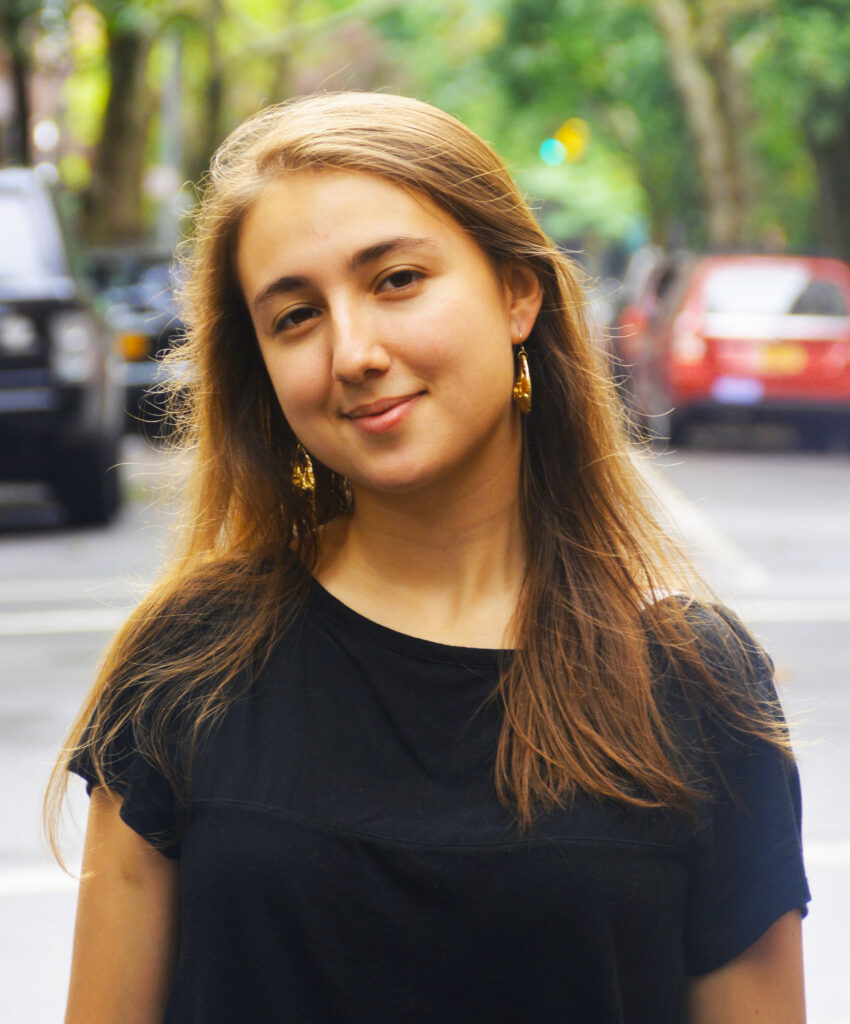
Born and raised in Brooklyn, NY, Raquel Acevedo Klein is an active conductor, vocalist, composer, and instrumentalist. Raquel has performed at Carnegie Hall, Lincoln Center, Radio City Music Hall, Town Hall, BAM, St. Ann’s Warehouse, Celebrate Brooklyn!, the Guggenheim, Rockefeller Center, The Tonight Show with Jimmy Fallon, WNYC, and elsewhere.
Recently, Raquel was commissioned by Little Island to premiere Polyphonic Interlace: a surround-sound music experience she composed using 40 layers of her own singing voice. Polyphonic Interlace went on to be performed by American Composers Orchestra in their first concert since the pandemic. As part of NY PopsUp, Raquel curated the four-week festival entitled NYC FREE, to celebrate the opening of Little Island. Her performances and curations have caught the attention of publications including The New York Times, The Los Angeles Times, The New Yorker, and Time Out New York.
Raquel conducts for the Grammy Award-winning Brooklyn Youth Chorus and New Jersey Symphony Orchestra among other projects. She has premiered works and operas by Philip Glass, Caroline Shaw, John Adams, Nico Muhly, Paola Prestini, Bryce Dessner, and George Lewis to name a few. She has recorded and performed with artists including Glen Hansard, Arcade Fire, Bon Iver, The National, Grizzly Bear, Cory Smythe, Sufjan Stevens, The Knights, NY Philharmonic, and International Contemporary Ensemble among others.
What’s your origin story, starting from where you were born to where you are now?
I was born in NYC to a Puerto Rican, Colombian and Jewish family of visual artists. I currently live 2 blocks away from the house I grew up in. I was the first generation in my family to go to college and get a degree. While my parents impressed upon me the importance of getting a degree, they made sure to introduce me to as many artistic outlets as possible. By high school, I was traveling on my own to rehearsals all over the city, jamming at Smalls, singing in large-scale musical theater productions, operas and classical masterworks, playing Arabic music recording with indie rockers and studying art at Cooper Union and FIT pre-college programs on the weekends. I fell in love with music by going to shows all the time and met so many people that I consider my closest friends and colleagues to this day. Growing up in NY, I discovered my love of music through all of the people that I met at shows, recording sessions, productions, you name it. Through such wide range of performance experiences and private study, I learned all different kinds of music, ranging from classical to jazz through piano, opera and contemporary music through voice, and electronic music and Arabic music through theory.
“I used my skillset as a producer
and curator to create a performing
arts platform”
As a freelance composer, conductor, curator and performer, how do you choose which projects to take on?
In addition to falling in love with the music community centered around NY, I was lucky to find such nurturing teachers who I continue to study with to this day. All of my teachers and collaborators taught me to approach music holistically and encouraged me to create a career path shaped by my own interests, not a pre-determined set of rules. By the time I encountered the, “You must do this in order be this type of musician” in college, I had enough experience to prove otherwise. I along with the producers and performers that I work with, continue to fight for a performing arts world devoid of prejudice, and instead fight for inclusion.
You have many different creative interests, how do you make time for each of them?
Balancing a wide range of interests and skillsets is an ever-evolving process. When I was fresh out of college I used to conduct rehearsals from 5-7pm on Weeknights. On Wednesdays I would bike straight from rehearsal to figure drawing sessions that I would lead from 7:30-10:30pm. That enabled me to maintain my draftsmanship and drawing skills. I take voice lessons and piano lessons each week which ground me in my singing and piano practice. I prioritize practicing voice at least an hour a day. However, when I am on a conducting gig, I give myself permission to go on vocal rest because that too is important to the health of my instrument. Here is where things get tricky: as a composer, I thoroughly enjoy writing music at ungodly hours of the night–a time when the world has gone to bed and I can find the most focus and creativity. My ongoing challenge is how to do that without compromising sleep. One of my strategies that I discovered during the pandemic, was creating a composing rig comprised of my laptop and a small, portable keyboard that I can take to Prospect Park. Turns out, I really love writing outside.
“a desire to sing with
other people”
How did the pandemic impact your creative life? What did that experience teach you?
Oddly enough, I felt emotionally and mentally prepared for the pandemic. After my family and I across Puerto Rico were affected by the aftermath of Hurricane María, I used my skillset as a producer and curator to create a performing arts platform that would galvanize people into paying attention to a mounting humanitarian crisis. Through organizing benefit concerts, I helped raise funds for victims and combat misinformation coming from the news and government at the time. In 2020, about a week and a half after lockdown, I launched Music on the Rebound. The festival witnessed a community of 4,600 people from all 7 continents come together and participate in a live, interactive performance of Pauline Oliveros’ Tuning Meditation. It made waves instantly and was picked up by The New York Times, Los Angeles Times, NPR,… and has since been inducted into the Library of Congress. Therefore the pandemic has reaffirmed my calling for using music and art as a means of bringing people together amidst crisis.
What work that you participated in 2021 sticks with you most strongly?
I created a multichannel sound installation entitled Polyphonic Interlace. Writing Polyphonic Interlace, I responded to a need I felt in the pandemic, which was a desire to sing with other people. There were a lot of safety concerns and things at stake for choral music. It was hard to create a sense of robust choral sound safely. I wanted to create a piece that enveloped the listener with an orchestral, symphonic sound. I decided to make a choir of myself. It is 40 voices of myself recording on top of each other. It was amazing to create a piece where I could showcase all of these timbres and colors across my entire vocal range. Because community is essential to my work, I engineered the piece so that the audience could participate as well. They were able to play different sub-mixes of the piece from their phones and walk around each other as if they were singing through my voice safely.