

mailing list

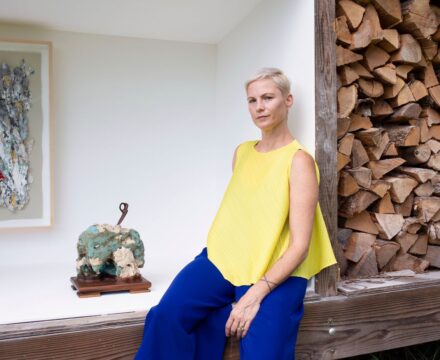
Johnson Hartig is an American fashion designer. He co-founded Libertine and is the CEO and Creative Director of the fashion line. Hartig’s work has been featured in Vogue, The World of Interiors, New York Times, and has been worn by a number of celebrities. As the founding force behind Libertine, Johnson Hartig ups the ante in fashion by creatively immersing himself and those around him in a whimsical trip where old school classics meet new school know-how. Championed by the likes of Anna Wintour, Karl Lagerfeld, Future, Mick Jagger and Cher. Libertine is internationally recognized as a brand with a devout cult following extending from east coast socialites to west coast creatives and back again. In essence, the longevity of Libertine’s apparel spanning over 15 years in the spotlight is a testament to his talent.
Lets’ start at the beginning – how did you get into fashion, and journey to launching Libertine? My grandmother taught me how to sew, using my mother’s 1950s singer sewing machine. Simple straight stitch, sixteen years old in the late 70s. Punk and new wave was a vital time in LA. The crowd I ran with wore and bought exclusively thrift shop clothing, they’d take it apart and put it back together, and so I developed an eye for it too. In the late 90s, when I was acting and modeling, I would make the clothes for myself. The buyer Cliff Fong from Maxfield’s LA saw me wearing something which I had made, (these pants) and asked me to make them for Maxfield. Then Colette saw them, Ron Herman in LA saw them, Joyce in Hong Kong! I met this woman, Cindy Greene, who lived in New York. A mutual friend introduced us, and said we’d probably like each other a lot. I went to New York, and in her studio we made fifteen vintage shirts, and I took them to Ron Herman. They sold out in forty five minutes! They needed twenty more within the next few days, and within six months we both had to leave our jobs and focus on Libertine. It was incredible! It doesn’t really happen that easily most of the time. I didn’t know anything about running a business, I worked backwards!
How did you find stores to sell the Libertine product to? We never made single phone call for the first eight years! They would come back and see us, and we would have to turn people away all the time. We couldn’t keep up with demand! Youth is wasted on the young. We had to turn down press because we were too busy, or didn’t feel like it. Now we spend so much money on a PR person, and I think “God we had it so good back then“. It all happened very organically, and naturally.
Was this the power of your network, working? No I don’t think so, we were all doing our own thing, we had an incredibly great idea at the best moment. The synergy was divine, and it came together so naturally, easily, and beautifully. Everything at that point was one of a kind, and had a real appeal. Very handcrafted, one could see evidence of the human hand work, a real rough quality of Libertine at that point.
How do you find that Libertine has changed over the years, and the fashion industry as a whole? We’ve changed considerably. We now produce our own fabrics, printed in Italy. In the last couple of years I’ve become this trunk show monster that is on a constant circuit. We do such incredible business at these trunk shows. Our business is stronger than ever in brick and mortar, at a time where everyone else is having a very difficult time. We’re slowing making adjustments when we feel like we need to, such as developing a stronger website to sell more online. Fashion as a whole, honestly I do not pay much attention to.I’m just not that interested in the fashion industry, I don’t know how it’s changed or if we’ve changed to adapt to it. The constant struggle to keep up with people knocking us off, has been the most difficult thing – including the largest selling luxury brand in the world.
Gosh, what happened?
Well, I don’t want to mention it, but it’s just very obvious that one of their best-selling collections was based on two very clear ideas of Libertine, the two previous seasons. I thought maybe I’m imagining it, but when I saw two of our ideas represented so highly, and heard from other countless designers who knocked them off too – it’s not a coincidence.
How can designers ideas can be better safe guarded? I don’t think anything can unfortunately. CFDA tried, (and was unsuccessful) to get these bills passed, but it’s too difficult to prove. These multi-national brands have fleets of lawyers waiting for their call. When we wrote the letter, essentially what they wrote back was ”yeah we are knocking you off, what are you going to do about it?” It’s the attitude, “what are you going to do about it” – I drive myself crazy by ruminating over it. I let it really get to me last year, and this year I decided that I just have to keep my nose to the grindstone. If our business was suffering that’d be something, but our business is better than ever. Major conglomerates are concerned with bottom line, yeah what are you going to do, I chose to go into this industry, that most major companies want to appropriate.
It can be viewed as a compliment…Yeah, that’s what I keep being told, it’s my DNA and it’s up to them and they’re the one who’s going suffer.
You have your trusted customer base, and you (and they) know that you created the original…Yeah, we’ll think of the next thing…

Ok, tell me about the next collection It’s kind of been a frustrating one. Now, whenever I design something I think it looks like something that so and so did. It’s an aesthetic that I developed and people have appropriated and now I associate it more with them than myself! Luckily I have more ideas, and it is going to be fine. In the middle of the season there’s always this panic moment; ” is what I’m doing interesting?” And then the ideas come and its always fine. The lesson is to not get too involved with those emotions of self-doubt when they arrive, and realize it’s going to be fine.
It’s part of being a creative. It’s a really tough circuit that we work by, and it’s not always easy to be forced into being creative all the time. There are moments where we just need a break, and the nature of our business doesn’t allow breaks. I do what I can to take care of myself, and travel for inspiration.
Where do you like to travel to? India, most of all. I went five or six years ago, and I’ve gone every year since. I just felt like I was home when I went; the culture and the clash of textures, colors, and fragrances. It’s the most sublime!
Do your trips influence your designs? Absolutely, everywhere I go. Often not in very obvious ways, and I never know when something is going to surface. My father’s job took us all over the world as a teenager, so much inspiration comes from exotic places.
I adore how elements of your collections have a strong Brit vibe, tell me where that’s derived from? It’s interesting, because I’ve always been an anglophile since I was a teenager but, I think that’s because of the Face and i-D. Those were our bibles. And the music! Everything that was interesting, was happening there. I actually found out last year from a DNA test that I’m 70% English, it makes more sense now. Architecture, to garden design, to decorating. England is what I look at first for inspiration!

Do you visit England often? Yeah every couple of years, many years ago I did an intensive study of English country houses in Yorkshire for ten days. A little bit more academic than I would have preferred, but invaluable now looking back on it. Other course attendees included university professors and museum curators, and I’m this kid thinking I’m going to see one house a day… but it was three or four houses a day!
Where is your most popular market? Here in America, and incredibly popular in Korea. We have such a loyal clientele in America, we are so lucky.
Did your customer base grow organically over the years? It has, yes, and from doing these trunk shows. Also the boutique in Bergdorf Goodman. We are opening a Libertine shop in Los Angeles in Fred Segal, 1000sqf to do whatever we want. It’s ten minutes from the studio, so if we feel like doing five T-shirts one day, and putting them there to see the reaction, we can, which is fantastic!
Do you get to be involved in the decor of how the store looks? They want me to do the whole thing. My house is published in ‘World of Interiors’. I think sometimes if I wasn’t a designer I would be an interior decorator.
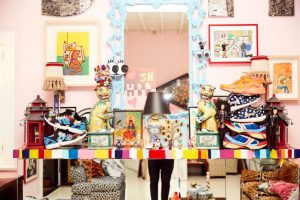
Do you think that’s something you would like to develop over the years? Yeah I’d love to, but just can barely keep up with demand for the clothes, at some point we’ll definitely be involved with. We just hired a consultant to get more of these things going.
What types of collaborations would you like to do more of? I should be doing rugs, interior fabrics, wallpapers, and creating these whole Libertine.
Your fabrics and could be great as framed art pieces. Yeah I was just going through this folder of silk screen we’ve done over the years, and just hung some up on the wall, they’re just fantastic…I studied painting and drawing in the university.
Where did you study? I studied here in Los Angeles
Did you know what you wanted to do when you graduated? No I didn’t, for many years just assisted people, worked in shops, didn’t have a lot of motivation. And then it all just quickly came together really easily when I met Cindy Greene, and we started Libertine together. Everything I did led to where I was personally. It takes a strong character to put yourself out there.
What advice can you share with future designers? Just do anything you have to, work with creative people you admire, cultivate unique ideas, and be prepared to work really hard, once it happens. From having young people intern here all the time, they’re a different breed than the generation before is. They’re expecting things to come more easily than they do, and seem unwillingly to do the work and do the research. I understand when you can press a button on a computer and find anything you need. There’s not a lot of motivation to go out and really establish ones identity and self-style, but its vital.
What affect is that going to have on society? I don’t know, I just don’t see that many parents emphasizing that strongly enough. I’m looking forward to retiring and moving to Mexico to an 18th century bed and breakfast, and leave it all behind.
In the UK, art is such an important subject, however it isn’t mandatory…There will always be a few originals, and a few that understand how vital art and creativity is, and it’s a shame that it’s the first thing that seems to go un-fronted in schools now. I think people are expecting less and less, and that’s why these fashion conglomerates can appropriate from small brands, and not feel like there’s any repercussions and people just sort of dumb down, and don’t expect anymore than that. It’s a strange time, who would have ever thought that this is what our country would look like. Politically, it’s like an episode of Black Mirror – we are being desensitized, and in some way we got what we wanted.
What do you think can be done to inform people how to vote in a conscious and meaningful way? It takes caring, it’s hard to distract people from their selfies and Instagram long enough to do the real investigating to become informed. We’re not going to get it from network news, one has to care enough to search it out. A few do, but as a mass population, we don’t, because then we wouldn’t have people like the Kardashians be as popular as they are. I think it’s all part of the plan to dumb us down, and sedate us. It may sound like a conspiracy, and maybe it is, but it’s going on – Trump is our president. This shouldn’t be going on. If we were more awake, it wouldn’t be. Better education, more funding for education, just the whole cycle. Until people stand up, and really demand it, nothing is going change.
Learn more about Johnson here >