

mailing list
“Don’t live life as if you are afraid
of being late to your own funeral!”
Lets’ start at the humble beginnings, tell me about your early life, and your journey to where you are at present…
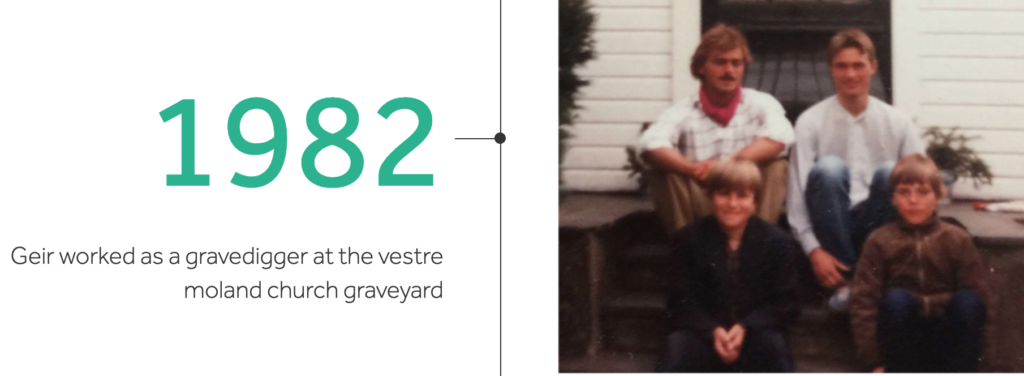
I was born in Oslo Norway, but grew up in Lillesand, an idyllic seaside town in southern Norway. Whilst studying, I combined study as a part-time graveyard digger, which gave me an early understanding of life and death and formed my life advice: don’t live life as if you are afraid of being late to your own funeral!
I studied physics and organizational psychology in the US for six years. Studying and working in the physics department at the university, I was most fascinated by the creativity of the physics society and how it operates by publishing research for feedback and how it gives a culture of good conversations and learning instead of politics and “hide and seek”. Einstein’s playfulness to his theories and his answer to why we have time, “so everything does not happen at once” has really influenced my thinking.
Studying for my masters in organizational psychology also had a strong influence on my thinking. My mentor and professor Benjamin Weybrew developed the ABC model of stress among personnel on nuclear submarines and wrote the book with the same name. The model builds upon a foundation of nearly 3 decades of stress research with atomic submarines. I am fascinated with how the findings in this research are highly relevant in reducing stress in modern organization.
Then I worked for Thyssen Stahl in Düsseldorf, Germany, and developed a Quality Assurance software system in India and became quality and HSE manager for Norway’s most significant chemical company before I started as a leadership consultant in London. I experienced a fast life with over 200 flight a year running change leadership programs for large corporate clients worldwide, which lasted for 6 years. During the time with a base in London, I worked closely with Keki Bhote, one of the world’s leading problem solvers.
In 1999 I founded The World Institute of Slowness that I sponsored through my consulting company.
Tell me about the world institute of slowness?
The World Institute of Slowness, a «practical» think tank, with the distinct aim to change the way people think about values, speed, and our approach to work and life.
You know, most of us can go through high school and university without really understanding what thinking is and how our thinking influences our lives. That is really a shame.
Our problems are not lack of time but the way that we perceive time.
Fast Thinking is your autopilot — automatic responses that dictate your thoughts, feelings, and actions. Slow Thinking is what’s happening to you when you turn off your autopilot.
Slow Thinking is the understanding of our thinking process and how thoughts make a reality, in uses the work at the Institute to make meaningful shifts in the workplace and individual values. We are working to facilitate a whole new mindset, away from the traditional perceptions of success and status symbols where factors such as health, relationships and environment aren’t subordinate. Our problems are not lack of time but the way that we perceive time. The purpose should be to provide and facilitate what a good life is: namely that you often smile, dream big, laugh, and realize what you really have.
SLOW+FILM-HD from geir berthelsen on Vimeo.
“Our society strongly programs us to think
that everything has a start and a finish line.”
How can slowness create a happier, healthier society?
A person’s basic needs are belonging, care and love. These needs can only be fulfilled through slowness in human relationships. We have to create a structure in our society that helps us nurture that we all feel more of belonging, care and love. This can only be reached through slowness.
On a personal level, get a hobby because it helps us to appreciate life here and now. It makes us less stressed because hobbies are not about getting to a finish line but it is about doing something you love. Our society strongly programs us to think that everything has a start and a finish line.
(the optimal thing is Hobby = Work)
A hobby is more like a dance, it’s about dancing not about completing the dance as fast as possible. The fastest way to good life style is to slow down
Has technology made us too fast?
The sole purpose of the technology should be to give us (humanity): «Time» or that a tool that makes us use time differently to become happier and healthier.
In many ways we used to live life as there were 24 hours a day there is still only 24 hours a day, but with technology, we have not taken time to take away the things we filled our day with earlier, so most people live their life with trying to fill 29 hours into 24 hours which is unhealthy over time.
Unplanned digitalization will causes negative consequences for people and in a way that technology will be running people lives on the premises of technology and not humanity
In what ways can technology help us to slow down?
To create a great digital world we need to understand and build on the true meaning of the word digitalization. We are growing our “fingers and toes” to reach more and live good lives (technology grows from inside out, not something that comes from outside….)
To achieve this business leaders and politicians, need to take a walk in the slow lane .
If we do it right technology can help us slow down. Perhaps, it is a fascinating question the most important question for our politicians and business leaders to be asked. We must also begin to create a new mind-set. Slow is important. We want the things we do not like to do should go as fast as possible, so we have more time for the things we like to do slowly. That’s what technology has helped us with.
What are your aims for the world institute of slowness?
The world institute of slowness aims to change the way people think about values, speed and approach to life. To promote a new way of thinking about time to slow the world down for a healthier, happier and more productive world.
“We need to shift focus towards
how to nurture”
How can we promote a structure that focuses on peoples’ needs, and not desires?
We have to accept that the foundation of our current culture is based on the opposite. We have to accept that our current culture is based on desires and is purposely made. Paul Mazer, CEO of Lehmann brothers 1930 said: « We must shift America from a needs culture to a desire culture…People must be trained to desire, to want new things, even before the old have been entirely consumed. We must shape a new mentality. Man’s desires must overshadow his needs».
We live in a culture that is purposely made our life in to rat wheel and solely aim is to consume in order to make economically growth. In order promote a structure that focuses on human needs we need to shift focus towards how to nurture: A person’s basic needs which belonging, care and love.
Where does the influence start? Government? The media? Brands and advertising?
The influence start with the media they make the narrative of the day/month/year/decade
The way that fits them in our current desire culture. Then advertising (what was earlier called propaganda ) makes stories about brands so they can sell a lot and at the same time fit in with current narrative that the media makes. Governments then ends up being the puppet on the string and is played by the media.
Pivotal moments in your career?
# 1 when we got our 2 twin boys Albert and Olav (17)
When I started as a graveyard digger
When I decide to study in the US
When I meet Anna, my wife an favourite artist
When I founded The World Institute of Slowness
When I became an art collector
Who’s been your biggest influence, and why?
My mum and dad by teaching me not to be in a hurry to find out what you want to become because you can do what you want to do. Still, in life I am not sure what I want to become when I grow up 😊. My mentor and professor Benjamin Weybrew who taught me about stress management and the importance of humour in life.
Being an assistant to Keki Bhote, one of the best problem solvers in the world. He taught me never try to solve a problem if you have no defined what the problem is.
” The fastest way to good lifestyle
is to slow down.”
How important is exercise and movement to you?
A long walk a day is very important for me
What do you laugh about?
A good joke. Some of Banskys art
What do you cry about?
The loss of close once I can also feel some tears if I listen to specific music or see a lovely artwork.
What rules do you live by?
The fastest way to good lifestyle is to slow down.
How do you get into your creative flow?
A good joke and good laugh or after meditation. I have always been fascinated by the links between humour and creativity. I believe there is no creativity without a flexible mind, and there is no humour without a flexible mind. If you laugh at a joke, you do it because you can see something out of ordinary context. The same happens if you find a creative solution to something.
What advice would you give to your younger self?
Remember life is like a dance. It would help if you focused on dancing, not that the dance will have an end. Do not fear dancing. The only way you can be better at dancing is to dance.
Tell me about your biggest lesson…
My biggest lesson has been the loss of trust in people I have had business dealings with.
I learned that the only way you can trust people is simple «you have to trust them.»
What does success look like for you?
I like Albert Einsteins’ definition:
What do you want to be known for?
The man that Slow downed the world! Then you can ask me: «what do you want to after you have slow downed the world» I would answer: « relax and slow down» then you could point out to me: «that is a lot of work just to slow down.»
Recommendations…
Music: Mozart, Beethoven, Bob Dylan, The National
Movies: Exit through the gift shop
Books: I am that by Sri Nisargadatta Maharaj
What’s coming up for you and the Institute in 2021?
It is very exciting year. There is 2 major areas we are going to focus on –
We have developed in cooperation with companies a new way of structuring organisation focusing on make work process look like a play or a game we call it “Samspill” which means playing together. The Fastest way to solve problems is to Slow Down! The Fastest way to increase productivity is style is to Slow Down”