

mailing list
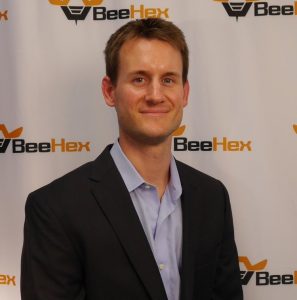
Benjamin Feltner is the COO & founder of Beehex, a NASA spin-off company modernizing food preparation and personalization with the most advanced 3D printing and robotics system in the food industry. Powered by patented technology that automates high speed food personalization for big and small food producers with greatest return on investment. With a mixture of cutting-edge software and hardware, BeeHex delivers the right recipe for accelerating food customizations.
Where did the idea for Beehex derive? So, John invented NASA 3D print system several years ago; so, this is part of a research and development project with NASA founded by SBIR which a small business innovation research fund. We are working on another one right now for the army. But back to the initial one – they were trying to figure out how to deliver foods with certain textures and things like that to astronauts on deep space missions.
Was that always the initial idea or did the involvement of NASA come later on? No, Anjan (co-founder) saw that solicitation, and thought of 3D printing food because of the solicitation. They had done a research on how much foods other than just pastes and powders have on your mental and physical well-being, and the mental aspect was significant. So, they could not just pre-package meals for which the shelf life is too short; they had to figure out a way to deliver food for a long period of time in space. So, he said “Oh, we can just pre-package long shelf-life food materials and ingredients, which is usually in a powder form, and rehydrate it and print it, things like pizza and whatever they want; and then you can bake it and make dinner” So, you’re creating a meal from nothing and they loved that. They started working on the project and it was politicized, because, although, the grant was pretty small in comparison to the funds and federal budget for sure, it was cut after phase one because some senators had made a show of “Look, what money they’re spending on 3d printing pizza”. That was not at all the intention, nobody was goofing around. But they made it into a political stunt; so, they cut that. Anjan monitored the spin-off and started the company based off it, because they got so many calls from people interested on all different levels. So, about a year later, (I’m an attorney) I met him in Houston, we became friends, and started to figure out how to start a company. We needed to raise money and things like that. So, we did that for a year and, now, we have earned our initial investor, Jim Crote, the founder of Donatos pizza, a popular chain in the Midwest.
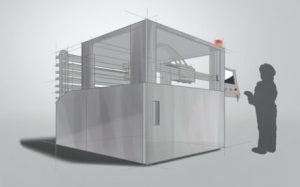
You mentioned the health benefits; do you see immediate results? Just in theory, because I have not gone on space missions with 3D food printer yet. But, in theory, yes, it would absolutely solve that problem. Now, we are not printing food for deep space missions, we are printing for here, on Earth. We’re going to spend time trying to figure out where this type of technology fits on the market. We have two different approaches to that. One is dessert decoration, because there is a shortage in dessert decorators, it’s kind of a dying art, but demand is going up. What happens is that the bigger companies just can’t hire talented people, because talented people start their own companies; people pay a lot for decorated desserts. I was shocked with how big the industry is, and how people just love the cookies, the decorated cupcakes, and cakes. But they all need to be hand-made if you want it to look decent. All of the machine-made ones right now, you know, they preset these big million-dollar machines to just draw straight lines, basically. So, you can tell when its machine made. But our machine is able to replicate what you can do by hand and solve a really big problem with some of these companies. So, we are doing dessert decorations, sold machines and those are being deployed soon.
How do you think 3D food printing is currently enhancing the current dining experience? Right now, it is a visual thing. There are a few companies in Europe that are doing a good job at making really pretty creations. You know, the medallions that have a hurricane type of drawing, really cool, they have a really interesting approach. Our machines are commercial based, so they are not nearly as small, but still print relatively small, but not like theirs. And that is enhancing the dining experience by just the visual aspect. Now, ours is high-speed, so we are not necessarily enhancing the dining experience for the baked goods, but just the ordering experience: people can get whatever design they want really fast. So, if you want it to say “Happy Birthday Johnny”, or if you’re having a party and want to have a clown or whatever, you can do that too. So, it allows you to be pretty creative whenever you want. So, it’s kind of “on demand” food.
Why is a machine so much faster than human? Well, for the machines build in Europe, it is not even close to being as fast, they just build structures which would be really difficult by hand. Ours are faster than the human hand. On average, one of the best decorators in the world would easily outmatch the machine; the only problem is that there are not that many of those people. So, ours are faster because they are pretty heavy-duty motors and our pressurized extrusion system just works the way it should. We can crank up the speed or knot, based on how delicate we want to be with the design. If you have ever done any hand piping for the desserts, it’s really difficult, and you make mistakes; and our machine just does not make mistakes or makes very few. So, it will do a perfect job. If you wanted a perfect circle, that’s really hard by hand, but our system will just do it. There is no needed concentration, the machine does not get tired. So, that, overall, just makes the whole process faster.
What was the feedback from the people trying it? Oh, fantastic, never a bad review. We also printed cauliflower dough, and the machine does a really good job on both of those, really high hydration dose. And the feedback was fantastic. We even went to an event where we were just paid to cater. We had no catering experience really. They said “you know, we need 300-400 pizzas”. And we were like “oh jeez”. We had two engineers, and a lawyer, and no one in the food industry, you know, we were learning at the time.
How did it go? Well, we were right next to National Caterer, and they had a bunch of pizza and other dishes. Ours were gone immediately, and they had a bunch leftover. So, the whole thing was a great experience. And it was really good. It always was after we started to learn a little bit about it and we just realized that we are kind of using automation but in a fresh food setting. It just results in consistency and, depending on the ingredients, really tasty food. Right next to us, they just pulled their pizza out of the freezer, and they were almost terrible. You know, these guys, they get paid to do this and they’re not even that good. That’s why everyone just gobbled up ours and they were asking to make more, but we did not have enough ingredients.
Were people watching the pizza being printed? Oh, yeah! They were all watching
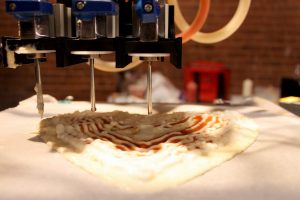
Wow! What was their reaction? Well, it was a bunch of engineers, so they came out with a little different approach than a normal consumer. A normal consumer, they would be like “you can print anything? I don’t get it. I don’t get what is going on. Can I really eat this?. The engineers just looked at it and asked a couple of questions, and they would eat it, to them it makes perfect sense. They are not scared at all for it to be hyper processed or anything like that, they knew what was going on, they just thought it was cool. They understood pretty quickly, in general, what was happening. But the consumers were a little scared, but then always had fun with it. It will be something that people will start to accept overtime, I think. Nobody is just terrified or “I’m not even going to try it”, it’s just a little bit of skepticism.
How soon will it be until everybody has 3D food printers in their own homes? Well, there are a few things that need to happen. There is a company called Natural Machines that makes 3D food printers that can go into homes, and that is expensive. Now, ours are a lot more expensive, but they are made for commercial settings. So, our customers get a really quick return on investment, it pays off almost immediately. But when it’s a consumer, do they really want to spend $3,000-$4,000 on a machine in their house? Probably not. And with Natural Machines 3D food printer, you have to do a lot of work to prepare the food to print; and to me, that is kind of defeating the purpose. I never understood that from the beginning, who wants to do this work, so then a machine can do everything for you? It’s kind of contradicting the effort. You know, we will eventually offer something, and we want it to be really cheap. So, when that happens, a couple years from now, we’ll need to have the food logistics. That means people will be mixing up, blending things at home so that they can print them. We will be selling the food to them; they can just plug in the food: cartridge, print, and just throw away the bag. Then it’s really easy, and that’s the whole point, because eventually I want people to have a 3D food printer in every kitchen. There are so many different ways we can print; we can print solid foods too, like almonds, oats, and just about anything other than something large, like, you can’t just extrude an apple. But anything relatively small – we can do. So, once we have that food for people to just buy; then it can be bought on Amazon, it’s delivered, plugged in, and they can say “I want a pizza” or “a pasta” or something, hit print on the way home from work and it will be ready.
You mentioned printing an almond. Is the process of printing for every food type the same? No, it’s not. When we are printing the solid particles, which has been around for a while actually, we are just downsizing and adding a few components to it to control it. But when I say “almond”, I literally mean when you have a ton of almonds and you want to extrude them. For example, for The Army, we are making personalized nutrition, the recovery bars. If we want to include almond pieces or just whole almonds on top; it would literally be dumping the almonds in a tub. That’s what I meant, really. There is also a scientific component, can you actually print an apple from scratch, can you build up the structure? I think the answer is probably – yes, in a matter of ten years. We are still really far from that, but it is exciting to see that it’s possible. A set-up like that would certainly be a million-dollar machine, and it does not exist right now. But it’s pretty cool to think about; being able to build the skin of the apple, the cells on the inside, and actually print the whole thing, bite it, and it tastes like an apple. It will definitely happen, I just do not know how long.
Lets’ discuss nutritional benefits, an apple for instance? Apple from a tree vs a 3D printed Apple…They have the same nutritional benefits, but there is a longer answer to that. So, the project for The Army is personalized nutrition. We analyze someone’s DNA and their gut health, that gives us a whole analysis of how they process food, their allergies. For example, John and I process caffeine, milk, and certain veggies differently. So, he needs some more high fiber and moderate sugar from foods like date paste and prunes. And for me, more greens. I don’t ever drink milk, but something like that would be fine for me; higher protein. Once we know that, then we branch out an algorithm on the machine, and it prints a bar that is specific to the person. Everyone needs a certain set of vitamins and nutrients, fiber, all sorts of stuff every day, but that’s really hard to work that into your diet. The Army is interested in supplementing their diet which may be whatever; eggs, snickers bar, or what they have in their backpacks. If they are able to supplement that with the bars that we’re specifically producing for them, then they’ve covered everything for the day. Then they do not get any type of diminishing mental capacity or anything like that which might occur from some type of malnutrition. That is the most exciting, because we can see an immediate impact. Everything else is a lot of fun, but with this one we can really see that we can make a big difference.
How long will that project be developing? We are done with phase one, we are pretty close. We will probably have something for the market within a year.
Learn more about Ben and Beehex here >