
mailing list

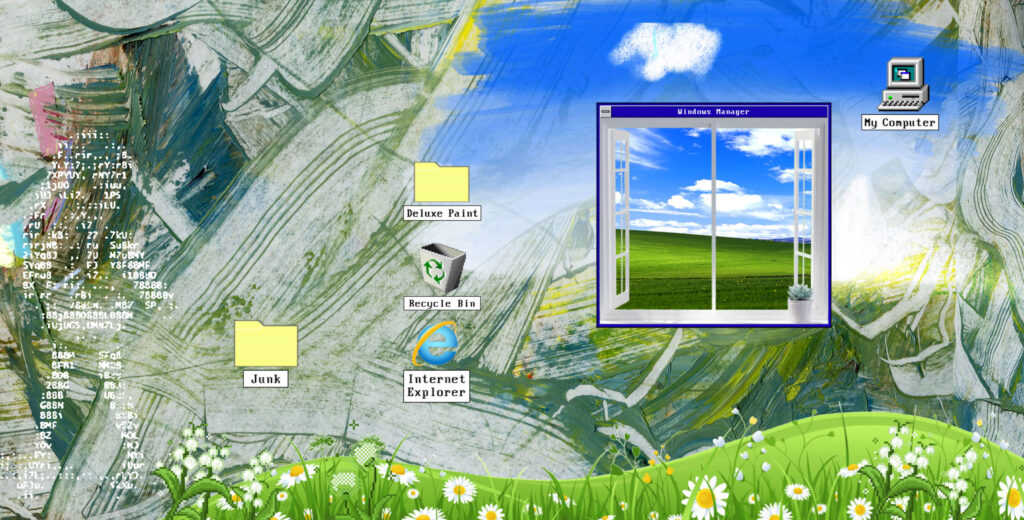
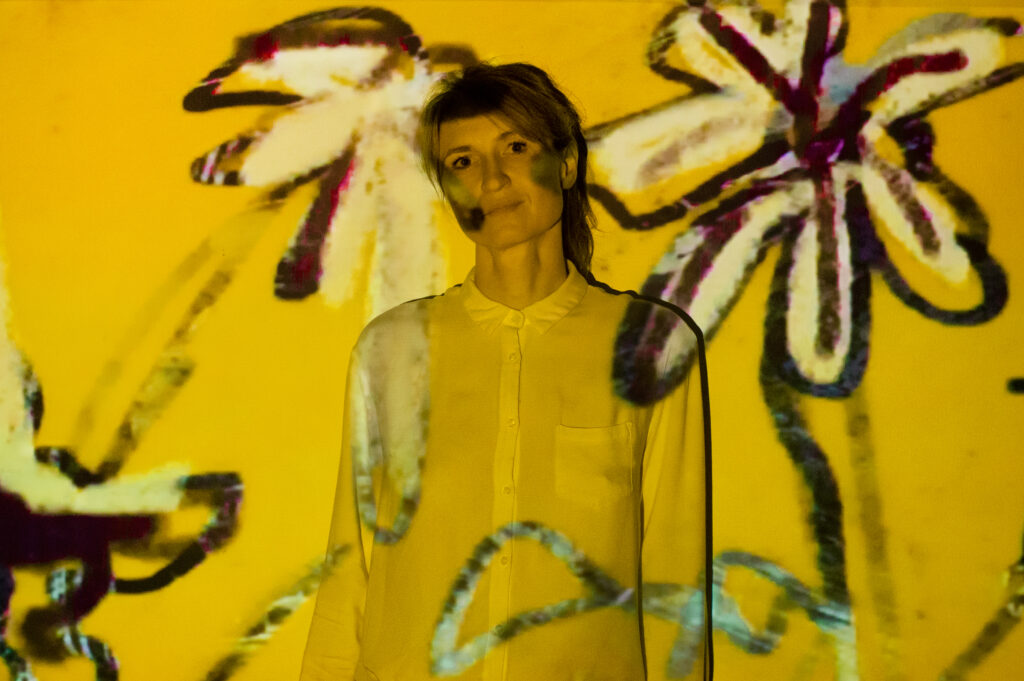
Maria Kozak is a painter and new media artist living and working between New York and Warsaw. Her family emigrated from Poland in 1983 at the height of martial law and she grew up navigating the two cultures. Her drawings and paintings are intuitive expressions of her inner world based loosely on society, nature and the sublime. They are about the absurdity of being a human, the dark comedy and the parts of the unconscious mind that we normally try to hide or ignore. There is always a duality present— whether darkness/light, control/surrender, stillness/movement, the real/artificial. Her virtual work is about the tension between repetition and change as we renegotiate what it means to be human in the digital age; as the boundaries between ourselves and others are constantly being redrawn. She has a light approach to social commentary, always seeking to provide a sense of levity and connection.
Kozak’s work is found in collections nationally and abroad. She has recently exhibited at Sotheby’s, The Detroit Public Library, and The SPRING/BREAK Art Show. Her work has been featured on Artsy, Cool Hunting, and in the WSJ. Kozak was recently awarded an NYFA/NYSCA grant and a Schusterman Foundation Fellowship for her work in emerging technology. She is an alumni of NEW INC, the
New Museum incubator for art and technology.
Tell us about your early life, and your journey to where you are at present.
I was born in communist Poland and emigrated here when I was a baby. I grew up navigating two cultures; my mother was adamant about teaching me Polish and making read the Polish books everyday after school. I am so thankful now but hated it at the time. The pressure to fit in and be American was always stronger so I denied that part of myself.
Tell us more about your Polish heritage…
It’s so fascinating to me. I have been thinking a lot about it lately and how it’s influenced me epigenetically. My parents were on opposite sides of the coin socially. My mother’s side of the family was aristocracy from Lvow, a part of Poland that is now the Ukraine. During WW2 their land was stolen from them by the Bolsheviks and they fled to Krakow. My grandfather was a captain in the cavalry and was captured and sent to a POW camp in Germany. After the war he struggled to feed his family, punished for his roots and having refused to join the Communist party. He went from being a count to living 9 people in a one bedroom apartment. His great-great grandfather, an illegitimate grandson of King, was a great patron of the arts. He oversaw the creation of Lazienki park and the royal art collection. He was also the head of the Rosicrucians, an esoteric masonic order centered around Hermeticism in the eighteenth century. He practiced alchemy and used Ujazdowski Castle as his lab until one of his experiments caused a great fire. Today the castle is the center for Contemporary art in Poland. I often wonder if this was the foundation for my interest in the occult and mysticism.
My father on the other hand was an active member of the party and a staunch socialist. My socially progressive political leanings come from him. He was a scientist, aeronautical engineer and met my mother when she was a translator at a conference. I know less about his side of the family. My mother fled Poland with me shortly after I was born because Marshall law was enacted but his other daughters, my sisters whom I met later in life all turned out to be artists and musicians as well. It is amazing the similarities we share despite being raised oceans apart by different parents.
Do you feel completely free to create the work and work that you desire?
I feel free in a sense of subject matter. With virtual reality and new media art I’m limited to what I can do technically by myself or what I can afford to pay someone. It has given me incredible opportunities to collaborate however, as with Jared Hoffman on our ThirdLife motion-capture piece, or with Yiting Liu who built the www.bucolicterrains.com website.

What has been a pivotal moment in your career?
Working as an assistant for the artist John Alexander really changed my life. He showed me what a real art career looked like form start to finish. Then going to grad school at the New York Academy of Art really gave me the skillset, confidence and most importantly a supportive community.
What’s your favorite part of the process?
The part when you are in the flow. It’s the best feeling, a loss of time and space. Showing your work is always fun. The worst part is always after a show, when you have been working so hard for something then there is the come down.
How did technology come to be such a large part of what you do?
I had always been a graphic designer so was already using digital art programs. I kept my work separate from my art for a long time but I shared a studio with Rachel Rossin for years who is one of the greatest artists working with tech today. I think I resisted it for years but finally caught the VR bug when I started thinking of world’s I could build.
What are you most interested to explore with emerging technologies?
I am interested how we can greater collaborate with machines and the new tools that will come out. I think am interested in the storytelling aspect. How we can make people feel and understand things more deeply.
What is one global issue you’d like to see solved with AI?
Though disease is a very pressing one at the moment, I think the sweeping advances we are going to make in every field with automation will unlock our human potential. To generalize, our primary function in society is labor. We are caught in an endless cycle working to live and living to work with consumption our main goal. As we move into a model of universal basic income my hope is that by investing in education and nurturing individual talents and interests, we may foster an army of creators instead of consumers.
What emotions do you aim to evoke when people experience your work?
I hope to bring people a little humor, a little bit of joy. Give them a break from themselves.
Who’s your biggest influence, and why?
My mother. She instilled the importance of being kind, the magic of art and an insatiable curiosity in me.
What have you found to be the biggest challenges?
To trust and let go.
Do you have a routine?
I am very adamant about getting 8 hours of sleep. Coffee, breakfast, then some laptop work. Lunch then three days a week we go swimming or on a hike or tennis. That is key. Then studio into the night.
What rules do you live by?
Everything is made up so it is your job to make it up great for yourself.
Help everyone you can.
Celebrate everyday.
How do you get into your creative flow?
Sometimes it just comes in the shower, or keeps me up late into the night, brimming with ideas. Sometimes an IPA. And a lot of dancing.
Talk to me about feeling ‘stuck’ – does this ever happen to you? How do you overcome it?
Yes all the time. John Alexander the painter I used to assist told me to just draw when that happens and not worry about what. Going to galleries really gets me wanting to make things. So do hikes. But there is also something to be said for a good Netflix binge.
We’ve spoken a little amongst ourselves previously about social media and it’s distractions, and the enjoyment of ‘switching off’ and enjoying nature – talk to me a little more about this.
I have a contentious relationship with social media. Even though for an artist it really is your best ‘wall’. It’s hard not to seek validation and tie your work to what gets ‘liked.’ I can go days without posting but it’s also how I sell a ton of work so maybe not the best strategy.
What do you foresee for the future for the creative industries?
I think more emphasis will be placed on the individual; less power in institutions. My hope for the future is that they will only grow. By nature our primary drive is to create.
What can we expect to see from you in the coming year?
I plan on spending the next few months on a new series of large scale paintings about the absurdity of being a human. I am also working on a VR piece about mediation.
What advice can you offer other artists regarding making their practice profitable?
I think get on social media, show your work as much as possible, organize your own shows. Visit galleries and find a community or artists to move in the world with.
What’s your philosophy for life?
Everything is made up so it is your job to make it up great for yourself.
Help everyone you can.
Celebrate everyday.
What advice would you give to your younger self?
Don’t doubt yourself or compare yourself to others. Tell the internal critic to sit the f*k down. Invest in Bitcoin.
Tell me about your biggest failure, and what you learned from that failure?
I don’t think there is one in particular but many many. I think the lesson is to get up and just keep failing. Each time brings you closer to what you want.
What does success look like for you?
Doing whatever I want at any given moment.
What do you want to be known for?
Making life a little less serious.
Recommendations –
Books; Big Magic by Elizabeth Gilbert is an excellent read for anyone pursuing the creative life. I also recently read Circe which was a brilliant retelling of Greek Mythology. Also Lo-Tek by Julia Watson, which shows us that to create a better future we must look to the past ie. how indigenous technologies can better create a more sustainable and climate-resilient infrastructure. Ted Lasso if you need a pep talk.
Visit mariakozak.com to view more of her work.