

mailing list

M. Pell leads The Microsoft Garage in NYC, part of the company’s worldwide innovation program for moving ideas forward quickly to foster a culture of experimentation. Bold, insightful, and uncompromising, Pell is recognized as a world-class designer and industry thought leader in next gen visualization. Pell’s evolution from intrepid entrepreneur, to VC-backed start-up veteran, to corporate man for Adobe and Microsoft has given him a unique perspective on how to combine business, experience, and technology to create breakthrough experience.
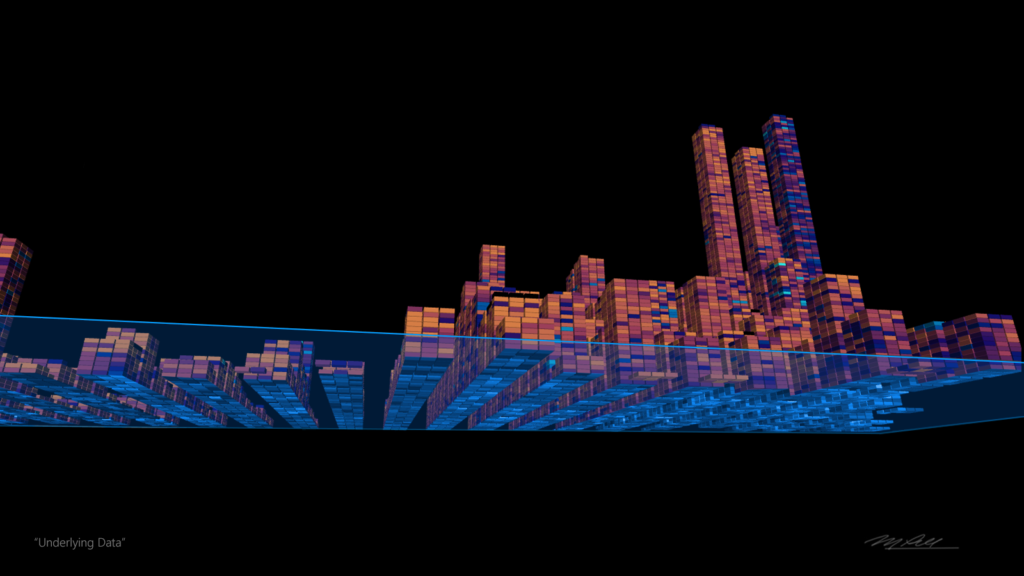
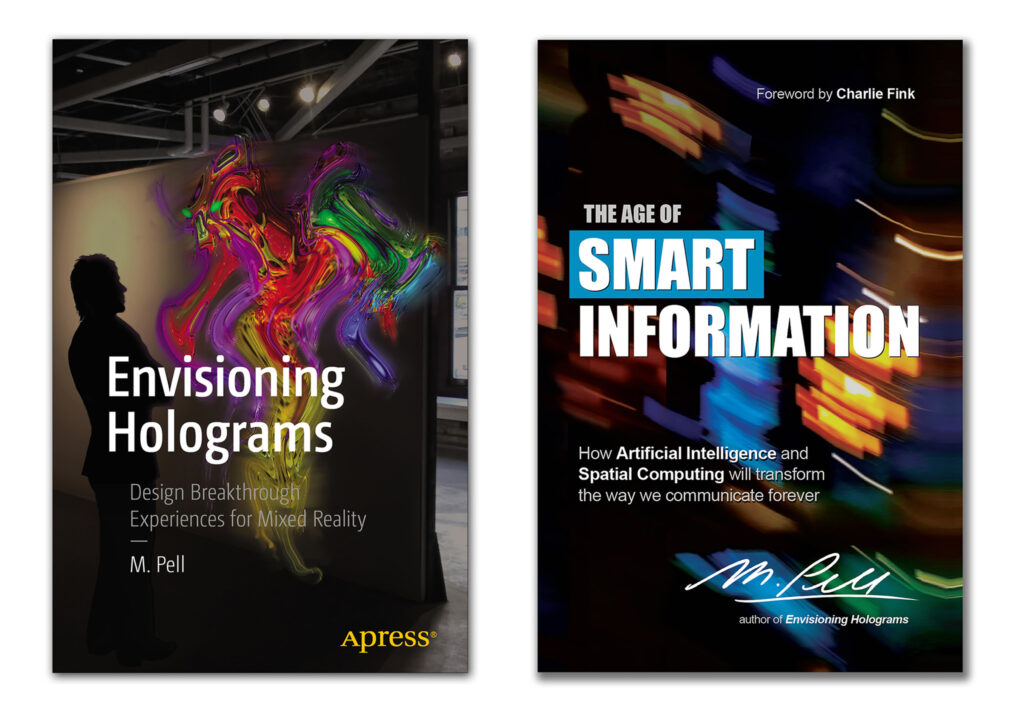
Pell’s first book, “Envisioning Holograms” is considered a must-have for tomorrow’s most influential storytellers and explorers. His second book “The Age of Smart Information” details how the fundamental nature of communication is transforming with the combination of AI and Spatial technologies. In his new interactive book, “Visualizing Business”, Pell illustrates how we can see the invisible workings and flows of global enterprises in an entirely new light.
Hello Mike! Thanks so much for taking the time to answer these questions. Talk to me about your current feelings and emotions…Hi Heather! It’s my pleasure – I always enjoy our chats about design and creativity. As far as how I’m feeling – like many of us, I’m happy we’re into the new year and really looking forward to getting past the challenges of last year.
Tell me about your early life, and your journey to where you are at present…I grew up loving science fiction, music, and motorsports – so no wonder I wanted to be an Astronaut / Rockstar / Formula 1 driver 😉 As a kid, I really enjoyed drawing and painting, being creative, and making things – so when it came time to decide on what to study in school, art seemed the logical choice. But, my love of technology, computers, and business took me in a different direction almost immediately upon getting to school. Fortunately, I’ve been able to combine both art and technology in just about everything I’ve done over my career.
What has been a pivotal moment in your career? Earlier in my career, it was that moment when I realized there’s more to be gained by not trying to get credit for my work, than fighting for individual recognition. When the work is high quality, people will find out who did it. It’s also a sign of maturity that you can be confident enough to let things accrue to your team or org, rather than to you personally.
Tell me more about the inventions which you have patents for? I was awarded over a dozen US patents for my work at Microsoft on Search systems – specifically, the way the user interface is presented and how advanced search functionality provides powerful new ways to focus and refine queries. Another bunch of Design patents were issued on Windows icons.
How did technology come to be such a large part of what you do? I always loved the vision of the future as depicted by science fiction as a kid, so it was natural to start using computers and tech to pursue that type of career. It came into sharp focus when I saw the original Macintosh computer for the first time. It was love at first sight when I used “MacPaint” to draw digitally. Completely changed my life.
You’re the Design lead of Microsoft Garage globally, what kind of work and ideas are created at the Garage? The Microsoft Garage is an innovation program that helps drive a culture of experimentation throughout the company, so we see a ton of different types of projects from employees and interns around the world – they really cover the spectrum. The common denominator for all of them is they come out of people’s passion to solve real world problems. We see every day that great ideas can come from anywhere and anyone.
Can you share some information about the projects you’re currently working on at The Garage? My focus is on launching our brand-new Microsoft Garage in NYC. It’s such a vibrant creative community and ecosystem. We have some great events and initiatives in store for this year. The Microsoft Garage Gallery online creative showcase being one of the first.
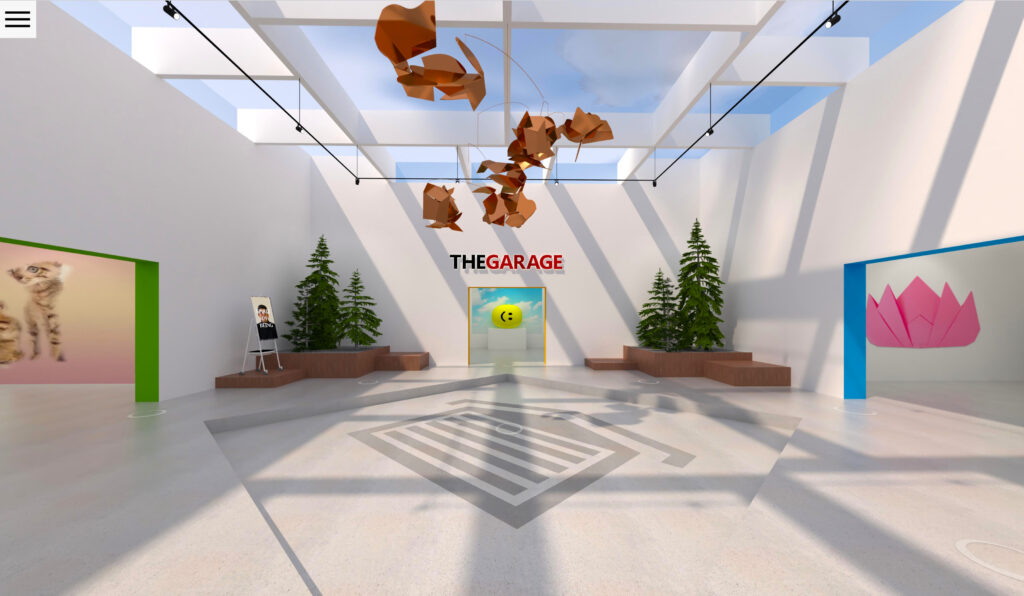
We’ve just collaborated on creating the Microsoft Garage Gallery, what do you envisage for the future of it? We’re starting by showcasing artists who are true innovators in their fields by using technology as part of their palette across various mediums. It will evolve to not only showing these types of innovative artists, but also expand to be an online showcase for creative hackathon projects that utilize both art and tech in their experiments.
“I like to think holograms are
our dreams made real.”
What’s your favorite part of what you do? Seeing the incredible ingenuity and creativity people bring to moving their ideas forward.
I really enjoyed your first book, ‘Envisioning Holograms’, simultaneously I was also dipping into a book on Shamanism – there were parallels between the two in regards to ways of seeing and training the eye. It compelled me to think visualising is not so dissimilar from meditating and envisioning with ones’ own mind, to holograms and virtual reality. What are your thoughts surrounding this? You are right that visualizing data or concepts is literally using the mind’s eye to come up with ways to convey information to other people – so in that way, you can think of it as being a similar process and practice to meditation and visualizing future outcomes. I like to think holograms are our dreams made real.
Do you think holograms, virtual reality and other new technologies will continue to aid visualization and creative thinking, and will we see a decrease in the more shaman and yogic ways of meditation and visualizing? No, I don’t think technologies like holograms and virtual reality will decrease people’s humanistic and natural approach to spirituality or meditation, but there is the possibility they will augment them in significant ways. People are already experimenting with using VR for meditations and fitness programs that have the effect of transporting you mentally into another state.
Talk to me about your book ‘The Age of Smart Information’ It’s an account from the future of where AI and Spatial Computing will take all of us in the next few years. Information will no longer be dead pixels on the screen – it will be dynamic and responsive in ways we haven’t considered yet.
What are you most interested to explore with emerging technologies? Visualizing dynamic ever-changing systems. We haven’t even scratched the surface here.
What is one global issue you’d like to see solved with AI? Early detection, diagnosis, and treatment of medical conditions. So much promise there.
In what ways do you foresee AI benefitting the creative industries? Our toolsets are being augmented by AI and Machine Learning processes that do much of the manual intensive work we’ve had to do by hand in the past. It’s really stunning what’s possible now. One simple example is Photoshop now being able to automatically make someone smile in a photo even if they aren’t currently.
In what ways do you see emerging tech and AI shaping our future lives? They already have permeated just about everything we come into contact with, we just haven’t noticed yet.
How is (and will) AI aid communication? By making it easier for people to consume (and generate) information of any type in the form that’s most appropriate for context and circumstances they are currently in. Automatically tailoring the form, level of detail, and delivery for the medium available to you in that moment will completely transform communications of all forms.

The year is 2070, tell me about your visions for what the world looks like, and how technology has shaped society? At this point, I just hope the world still exists in 2070. Can’t even imagine how fast the pace of innovation and societal change will accelerate in the next fifty years.
Will one of your future books be written with (or by) AI? Certainly, assisted by AI-powered tools – in fact, that’s already happening. Many of the tools we all use these days have AI and Machine Learning assisting us behind the scenes. It’s not marketed that way because we’re still figuring out what works and what doesn’t, but it’s in there today.
“Rules are for
other people”
Who are your biggest early influences, and why? Steve Jobs, for bold vision and megawatt charisma. George Lucas and James Cameron, for brilliant cinematic experiences. Roger Dean, for other-worldly illustration. Ronnie Van Zant and Neil Young for their transportive storytelling.
What have you found to be the biggest challenges, and learnings of 2020? As Creatives, it’s been hard to get that sudden spark of inspiration or much needed feedback when you’re not physically in the same space with people you enjoy working with. That’s been a real challenge for many of us. Biggest learning was how important it is to be empathetic for people’s remote working situations – many are not optimal. We all need to have more grace and patience.
What rules do you live by? Rules are for other people 🙂

How do you get into your creative flow? I’m very fortunate in that I can be creative “on demand” – no special approach or setup needed. I do love loud music and coffee, but don’t we all.
What can we expect to see from you and Microsoft Garage in the coming year? The Garage program continues to grow around the world, and we’re doing some exciting new experiments that take advantage of everyone being connected and available more easily than physical spaces afforded. As for me, my third book on next-gen visualization will be published later this year and I’m looking forward to some finishing some personal creative projects.
“We all need to have more
grace and patience.”
What’s your philosophy for life? I don’t know there’s anything I consciously adhere to, but I do believe we all have a responsibility to try and help other people in some way. In the end, the way you’ve shown up for other people is all that really matters, right?
What advice would you give to your younger self? Don’t sell that Adobe stock you got for inventing Acrobat and PDF.
Tell me about your biggest “failure”, and what you learned? There are so many, where do I start? The truth is I fail all the time, every day, in different ways – that’s the nature of experimenting and working so quickly. Fortunately, it always leads to learning something, so I don’t really consider it failing. I can tell you that a recurring failure for me is being too early or having ideas that are ahead of their time – as they say, timing is everything. It’s satisfying to know you’re on the leading edge, but there are no awards for being early.
What do you want to be known for? Being a good person.
Recommendations –
“Drawing Ideas” by Baskinger and Bardel – beautiful book on quick sketching techniques
“American Utopia” (on Broadway) by David Byrne – his entire musical catalogue is brilliant
“Quantum Memories” by Refik Anadol – leading force in visual storytelling using data and AI