

mailing list

G. Bruce Boyer is a journalist who was the fashion editor for Town & Country. Often cited as an authority on men’s fashion, he was formerly fashion editor for GQ and Esquire. Before his career in menswear journalism, Boyer studied English literature in Moravian and holds a graduate and master’s degree in the subject.
Hello Bruce! Thanks so much for taking the time to answer the questions. Talk to me about your current feelings and emotions…At the moment (January 14, 2021) I’m as depressed as everyone else. The pandemic, the political upheaval, the economic situation continue to contribute to our feeling of uneasiness because the future seems more uncertain than we would have thought a year or two ago, and courage and rationality seem in small supply these days. But as Albert Camus said, we must imagine Sisyphus happy.
Tell me about your early life, and your journey to where you are at present…Taking a tip from Henry Miller’s Black Spring, I am a patriot of the Sixteenth Ward, Allentown, Pennsylvania. Thank the gods our destinies are not written on our birth certificates, I was raised there in a blue collar neighbourhood of steelworkers in the middle of the 20th Century. It was the most beautiful place in the world, and all I l knew of the world from the time I was four until my family left the area when I was fourteen. Sometimes it occurs to be that I’ve led an aimless life. I hated public school, but luckily was able to go to college and university. I thought to become a teacher, and in fact taught for seven years, but wasn’t a very committed scholar and stumbled into writing about clothes where I’ve been happy ever since. It’s allowed me to travel and meet such interesting people. That’s the professional story in a nut shell.
Tell me a secret… I’ve never worked a day in my life.
You’re a major authoritative figure in men’s fashion – tell me how this came to be? My mother, in her great wisdom and tolerance, allowed to wear whatever I wanted to and I picked out my own clothes since I was four or five years old. How I dressed before that I don’t remember, probably I just wore any old thing. But picking out my own clothes allowed me to experiment with all sorts of things from biker jackets to Savile Row suits, I wore it all and learned what worked for me and what didn’t. I copied dressers and guys with style whom I admired. I also worked in a small clothing store for pocket money when I was sixteen and seventeen. I’ve never studied fashion formally or strategically, but read widely in the subject on my own.
What has been a pivotal moment in your career? On speculation I wrote an article on the Duke of Windsor in 1972 and sent it blindly to Town & Country Magazine. The editor-in-chief, Frank Zachary, just happened to be very open to taking on new writers and he bought the piece. I think the piece I wrote was well done, but it was just luck that Frank was in charge of editorial there. Young writers are very vulnerable, and I was so lucky to be encouraged from the start.
What defines style? One of the more difficult questions to answer, even though we all seem to know it when we see it. In the honorific sense, style is the triumph of the individual who has the courage to be him- or herself, and in that sense style’s the outward image of character. But what are the springs of this courage and the style that emerges from it? I don’t mean to get all psychological here, but the spring of style may well be a neurotic defence of one sort or another. We may cultivate style as a tool to deal with adversity. Just a pensee. The reality, undemocratic thought it may be, is that some guys and gals got it, and some don’t.
Tell me about your new book…I’m working on something completely different, a collection of music essays on Early Rock, Classic Jazz, and Blues that I’ve been compiling. I’ve been a fan of this music since I was very young, and the essays take the form of what’s known as “memory history”. I’m now looking for an illustrator and then a sympathetic publisher.
The year is 2050, what does the luxury and bespoke industry look like? If I knew the answer to that question I’d be phoning this in from my small mansion in the lavender fields of Provence. I can’t imagine I’ll even be alive to see what happens to the Kardashians.
What impact do you think Brexit will have on the UK fashion industry? Particularly for UK brands like Savile Row…I must admit that I thought and still think the Brits made a mistake in retreating from a unified Europe, and can’t really see that there will be great advantages in the future for them. On the other hand, the referendum was the will and wisdom of the majority of the British people and deserves to be respected. Selfishly for myself, I hope it means British goods will be less expensive for us in the USA because I happen to like British styling and craftsmanship.
Talk to me about the leading global style cities, who does it best? It used to be London without question, followed by Milan, Paris, and New York. But in the last half-century a homogenous force has made these cities almost indistinguishable as the major designer brands have usurped most of the street space and knocked the wonderful small shops into oblivion. If this trend continues one can only envision the choices of clothing shrinking into communistic sameness. On the other fashionable hand, the trend, at least in New York City, has been for smaller shops to spring up in lower-rent parts of the city and catering more to niche consumers. This seems altogether healthier to me than the sameness of the gargantuan box stores where the philosophy is that you’re just like everyone else and so you should buy something that continues to make you like everyone else who’s bought the same thing.
Wearing great clothes ‘makes one happy’ – talk to me about your thoughts surrounding the psychology of image? I always feel I’m a better person when I’m properly dressed and have a glass in my hand. It gives me confidence and puts me at ease, and I think when we’re at ease we put others at ease as well, so that’s all very helpful. But I may have grown up in the last age in which people dressed in order to look better, rather than merely look like everyone else. I think homogenization has become more and more the dominating trait of our culture. And to be like everyone else can provide a great deal of security both physically and psychologically, but like any uniform not only distinguishes who is a member of the group, but who is not. It’s the latter that can have dire consequences.
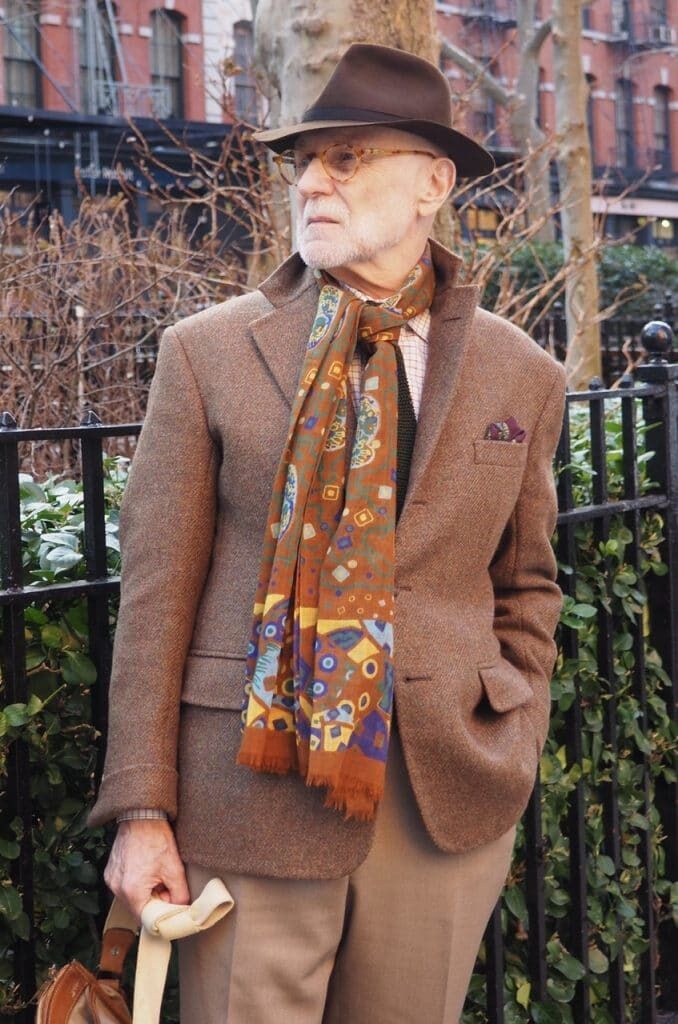
Talk to me about your thoughts surrounding sustainability and the fashion industry…If by “Fashion” we mean the constantly buying new clothes and throwing away the previous ones – Shakespeare said that “Fashion wears out more clothes than the man” – more and more of us will not be unhappy to see its death. For myself and my work, I’ve always argued that it’s best to buy the best you can afford and keep and maintain it for as long as you can. This I think is true for a thousand reasons, not the least of which is that it’s less expensive for the consumer. But the environment must be our primary concern now simply because if we fail to reverse current trends in the ecology nothing else will matter. In short, sustainability is now fundamental to our quality of life and quite possibly life itself.
Talk to me about love, passion and desire… If by “love, passion, and desire,” you mean sex, there are no secrets. Only enthusiasms.
What have you found to be the biggest challenges, and learnings of 2020? For me they’re all technological. I’ve been brought kicking and screaming to the higher forms of technology, so the biggest challenges for me are simply to learn as much of the basics as I can. It’s made me aware that I no longer share the world with the young, that I continue in my writing to struggle to find relevant metaphors, and that simplicity seems to become more a virtue every day.
Who’s your biggest influence, and why? The problem here is that no one knows the people who most influenced me most because they were first my family, later the guys in our neighbourhood who were slightly older than me and “cool”. We all went to the movies, so movie stars were an influence on our dress and deportment. I was particularly influenced by Fred Astaire because I loved to dance and Astaire appeared to have such naturally graceful and stylish moves and was so casually elegant. He helped me develop my ideas of sprezzatura. Finally I should say my college teachers who graciously introduced me to so many intriguing ideas. After that everything was of secondary importance.
What rules do you live by? In my moments of disturbance and faintness of heart I try to ask myself what my mother and grandparents would think of what I was doing, would they be proud of me, and also to remember the many kindnesses done to me over my years in the world. I say this because it’s always been clear to me that I’ve been given more than I’ve given.
How do you get into your creative flow? Most people when they’re young work at something because they’ve interested in it. The trick has always been to make a living at something you like. It’s the easiest way to function. But if the juices don’t automatically flow you must work at it til it becomes interesting. Someone once pointed out that anyone can do a good job on a good day, but a professional is someone who can do a good job on a bad day. A pro finds ways to free himself psychologically from the impediments he encounters, and these techniques become habitual.
Talk to me about feeling ‘stuck’…Being “stuck” is the result of two things: (1) a lack of knowledge or understanding of your subject, and/or (2) a lack of will, a fear of saying what you mean and know to be true. The first reason can be easily overcome with research and quiet contemplation. The second may take a lifetime of testing, and some never reach the goal.
What can we expect to see from you in the coming year? I’m hoping to become the coach of a major football franchise, be the first man to climb Everest backwards, and corner the market in Titanium. Failing that, I’ll settle on getting my music book published.
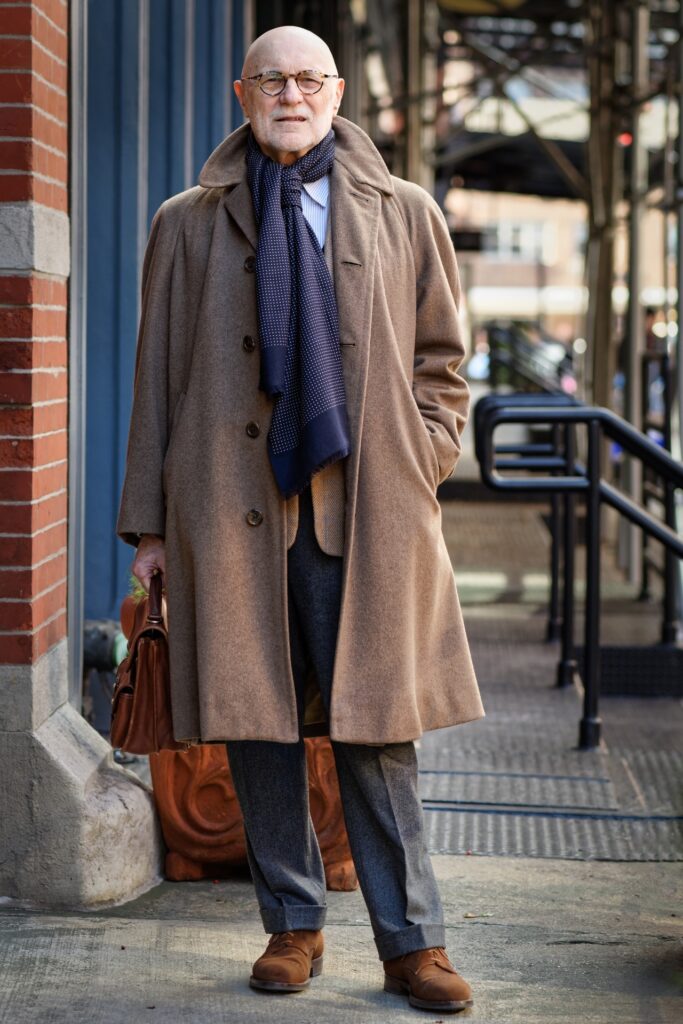
One of the many things I adore about you, is how you don’t have a cell phone. What advice can you share with others with regards to ‘switching off’…I’m probably completely wrong about this, but it often occurs to me that a bit of solitude can do wonders for our personalities and our ability to think Funnily enough, when you realize that we’ll all expendable (and easily forgotten), life becomes much less hectic.
What’s the most interesting fact that you discovered recently? That so many politicians are even more spineless and cowardly than I imagined.
What’s your philosophy for life? In my waning years I’ve taken a tip from the poet Phillip Larkin: “We should be kind, while there is still time.”
What advice would you give to your younger self? Be more courageous, and follow your intuition because the great tragedy of life is that we mostly regret the things we haven’t done than the things we have.
Tell me about your biggest life lesson? Not trying to become a writer sooner. I should also liked to have been a musician, I admire them so much.
Recommendations…With the pandemic I’ve had a lot of time on my hands and have done considerable reading. Of the recent books I’ve been particularly impressed with Henry Miller’s Black Spring, Leonardo Sciascia’s The Day of the Owl, Eric Hobsbawm’s The Jazz Scene, the poetry of Phillip Larkin and Langston Hughes, I continue to be impressed with the blog sites of Derek Guy and Michael Drake. My tastes in music (as in clothes) are so imprisoned by the tastes of my youth that I find myself returning to those things I’ve heard before, and keep enjoying them anew. Recently I’ve been listening to Carl Perkins (Live at the Lone Star Café) and Jerry Lee Lewis (Another Pace, Another Time), Nina Simone (Live at Newport) and Joe Williams (Live at Count Basie’s). I recently bought the DVD documentary of Norman Lewis’ book Naples ’44, which I hope to look at this weekend.